
EV Industry in Flux: Innovations, Setbacks, and Shifting Strategies in December 2025
EV Industry in Flux: Innovations, Setbacks, and Shifting Strategies in December 2025
As the electric vehicle (EV) revolution continues to reshape global transportation, the latest developments across the sector show a mix of breakthrough innovation, shifting corporate priorities, and political recalibrations. From experiments in off-grid charging systems to carmakers revising their once-bold electrification commitments, December 2025 has demonstrated how dynamic—and volatile—the path to a sustainable future remains.
Off-Grid Charging Gets a Grease-Fueled Boost
In rural Western Australia, innovators are tackling one of the EV movement’s biggest challenges: how to enable fast charging in remote areas far from grid infrastructure. A new initiative is turning to an unconventional energy source—used chip oil—to power off-grid DC fast chargers along outback routes. The project aims to provide dependable access to renewable charging stations for long-distance travelers, paving the way for broader EV adoption in remote regions. The success of these systems illustrates the growing creativity within the industry, where biofuels and hybrid renewable technologies are being used to plug the accessibility gaps in vast, energy-scarce environments.
Adding to this innovation is eLumina, a company leading the integration of battery-backed systems that combine solar generation with smart energy management. The approach not only powers remote high-speed chargers but also demonstrates how distributed energy systems can coexist with the mainstream grid while maintaining reliability and low emissions.
Tesla Raises the Bar Again With Model Y Performance Overhaul
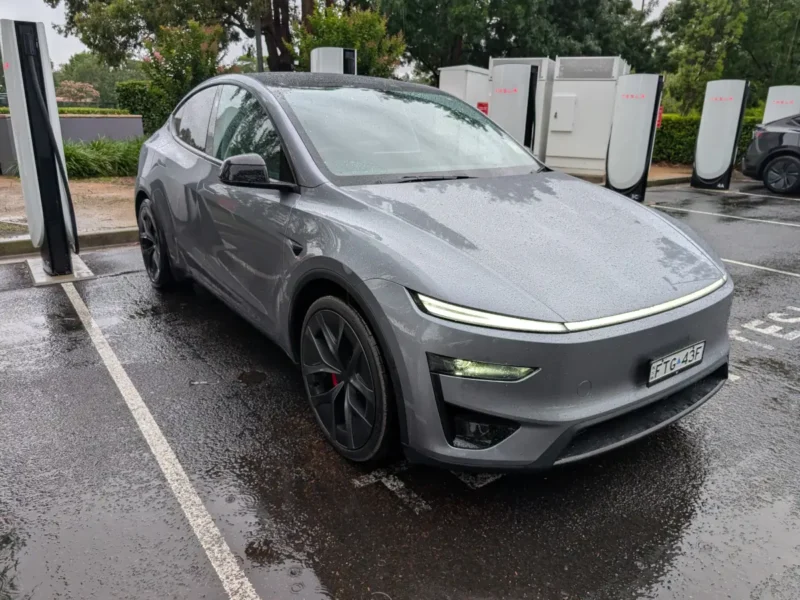
Tesla’s new Model Y Performance has arrived, setting a higher benchmark for the compact SUV market. The latest model features major handling improvements, refined suspension balance, and a notable uptick in performance. While Tesla enthusiasts are accustomed to incremental software updates, this year’s hardware overhauls mark a substantial shift—especially in how the automaker distinguishes the Performance variant from its Long Range sibling. Reviewers highlight that the larger gap in specs now justifies the price difference, reinforcing Tesla’s strategy of merging driving excitement with clean technology.
Industry Giants Converge on Electric Rail and Budget EVs
Fortescue Metals Group, a major player in global iron ore supply, has taken another decisive step toward decarbonizing heavy industry. The company recently debuted its second battery-electric locomotive—a powerhouse carrying 14.5 MWh of energy storage capacity. These locomotives are integral to Fortescue’s plan to reach genuine zero-emission operations by 2030. In a sector often overlooked in the EV conversation, this advancement signals how quickly electrification is spreading beyond passenger vehicles.
In more consumer-oriented news, GWM, the Chinese automaker behind the Ora brand, unveiled its Ora 5 electric SUV with a starting price equivalent to around $20,000 AUD. If the company proceeds with plans to bring the model to Australia, it could become one of the most affordable EVs available, marking another step in the industry’s push toward mainstream affordability.
Europe’s Policy Reversal: The ICE Comeback
In a surprising policy pivot, the European Union has rolled back its previously announced 2035 ban on new internal combustion engine (ICE) cars. Bowing to pressure from major car manufacturers struggling with competition from Tesla and Chinese EV companies, Brussels approved the continued sale of plug-in hybrids and range-extended vehicles beyond the original phase-out date. Critics say the move undermines climate goals, while industry defenders claim it provides breathing room for legacy automakers to adjust their supply chains, cut costs, and build competitive battery ecosystems.
The 2025 Ford Saga: From EV Pioneer to Retrenchment
Ford Motor Company made headlines with a major strategic retreat—absorbing a financial hit estimated at $29 billion while winding back its EV ambitions. The automaker dissolved a multimillion-dollar battery venture and shifted focus toward hybrid powertrains and gas-powered trucks. The company’s decision underscores the mounting financial and logistical strain legacy automakers face as they try to compete in an increasingly electrified market. Ford’s latest version of its iconic F-150 Lightning illustrates this pivot: the truck is no longer purely electric. Instead, it features an onboard internal combustion generator capable of recharging the battery on the go, serving as a stopgap between electric mobility and traditional fueling methods.
While Ford framed the change as an advance in range-extending technology, analysts view it as a setback for the fully electric truck segment. It reflects the uneasy transition phase now gripping the industry, where corporate commitment to zero-emissions vehicles can waver under financial pressure and infrastructure challenges.
Volkswagen and BYD Push Forward Despite Headwinds
Contrasting with Ford’s pullback, Volkswagen and BYD are forging ahead with ambitious electric programs. Volkswagen revealed details of its upcoming ID. Polo, an affordable compact model built on its popular EV platform. With four power levels and a re-engineered interior that maximizes space, the car is expected to appeal to urban buyers seeking efficient electrification without premium pricing.
Meanwhile, BYD—the Chinese powerhouse already dominating global EV shipments—unveiled early details from its upcoming Ocean Series. Two new models are scheduled for launch in early 2026, reinforcing the brand’s relentless pace of innovation. BYD’s sustained growth, coupled with its expanding presence in Europe, positions it as one of the main catalysts behind global electrification momentum.
A Crossroads for the EV Transition
The developments in late 2025 paint a picture of transformation and tension. On one hand, there is progress—new rail electrification milestones, more affordable vehicles, and technical ingenuity enabling off-grid charging. On the other, political compromises and corporate retrenchment threaten to slow the clean energy transition.
The industry’s next chapter will likely focus on reconciling these contradictions: balancing cost with climate goals, resilience with speed, and innovation with practicality. If the latest news is any indication, the EV story is far from linear—but its momentum appears unstoppable.