
Volkswagen ID. Polo Shows Small Electric Cars Can Handle Big Journeys
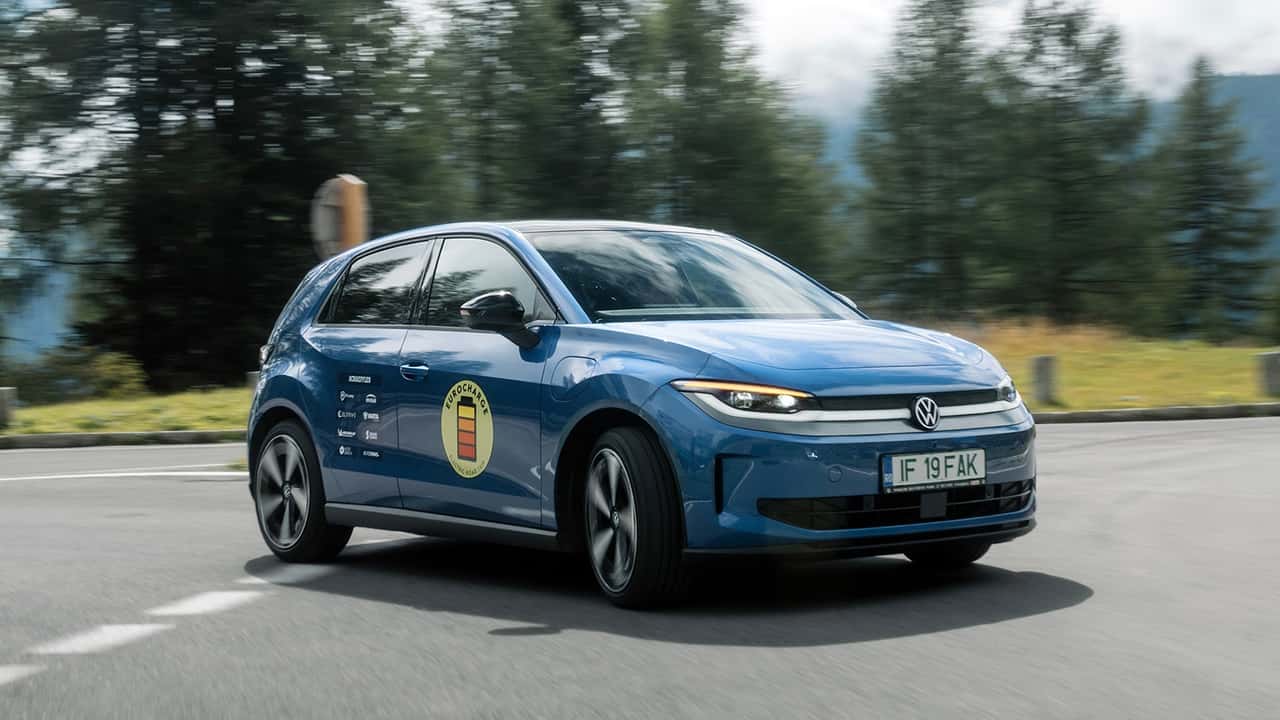
A premium-priced electric supermini with long-distance ambitions
Volkswagen’s electric ID. Polo may carry the name of a relatively small hatchback, but its abilities on a long European road trip suggest that it is designed to operate well beyond the city. With a Romanian-market price of approximately €39,500, the compact EV is not an inexpensive proposition. However, an extended drive across Europe showed that the ID. Polo combines comfort, efficiency and motorway refinement in a way that could make its price easier to understand.
The car was evaluated during the Eurocharge by Schaeffler EV grand tour, a cross-Europe journey that began in Romania and travelled to the sources of the Danube before returning. Across the entire event, the electric Polo covered 4,468 kilometers, equivalent to roughly 2,776 miles. One particularly demanding day saw it travel 507 kilometers, or 315 miles, from Enzklösterle in Germany to Hohe Salve in Austria.
That route included mountain roads, urban sections and lengthy motorway stretches, providing a useful mixture of conditions. The experience also allowed the Volkswagen to be compared directly with a Renault 5 E-Tech travelling along the same roads. Both cars are compact electric hatchbacks, and both use batteries with 52 kWh of usable capacity.
A more mature alternative to the Renault 5
The Renault 5 makes an immediate visual statement with its retro-inspired design. The ID. Polo takes a quieter approach. Its proportions are familiar, but sharp detailing and a more restrained design give it a modern and polished appearance. It looks like a conventional Volkswagen that has been carefully adapted for the electric era rather than a car designed to attract attention at every turn.
Inside, the Polo makes a strong impression for a vehicle in the supermini class. The Style version tested was equipped with numerous options, including electrically adjustable front seats with memory functions. The driver’s seat was described as comfortable and supportive, while the steering wheel offered enough adjustment to make finding a good driving position straightforward.
The cabin combines softer materials in frequently touched areas with harder plastics elsewhere. That is not unusual in this segment, and some more expensive vehicles use similar materials. More importantly, Volkswagen appears to have responded to criticism aimed at the controls of earlier ID models.
The ID. Polo features conventional steering-wheel buttons, physical climate controls and separate switches for all four windows. These details may sound basic, but they make common functions easier to operate without navigating menus on a touchscreen.
The digital displays also include a playful retro theme. The instrument panel can mimic the appearance of older Volkswagen dashboards, including a power gauge whose movement resembles an analog rev counter. The central display can show a cassette player-style graphic, complete with a tape that appears to move as music plays. Even the battery indicator and charging light adopt a vintage-inspired appearance in this mode.
Comfortable and quiet at motorway speeds
The biggest surprise came once the car was moving. At 130 km/h, or 81 mph, the ID. Polo felt stable and relaxed. Its ride quality gave it the composure normally associated with a larger vehicle, making long motorway journeys feel routine rather than tiring.
The suspension dealt effectively with bumps and road imperfections without producing excessive noise or harsh impacts. Wind noise was also better controlled than in the Renault 5, adding to the Volkswagen’s more mature character. A slightly longer wheelbase likely contributes to the sense of stability and comfort.
Despite using the less expensive front-wheel-drive version of Volkswagen’s MEB electric platform, the Polo was judged to feel more refined than the larger ID.3. It was described as the most convincing ID model experienced so far, although the larger ID.7 could eventually set a higher benchmark.
The car was less impressive when driven aggressively on winding roads. On Austria’s Hochtannbergpass, the front tires began to run wide in a corner, and the steering wheel provided little warning that grip was being lost. The Renault 5 offered more mechanical grip and clearer feedback, making it the more entertaining choice on twisty roads.
A future GTI version of the ID. Polo could address that weakness. Volkswagen has already indicated that a sportier model is planned, potentially giving the electric hatchback a stronger challenge against performance-oriented cars such as the Alpine A290.
Strong efficiency and useful real-world range
Efficiency was one of the Volkswagen’s most notable strengths. During the trip, the ID. Polo was more efficient than the Renault 5 on every day except one, when the two cars recorded the same result. At the end of the tour, the Volkswagen averaged 15.2 kWh per 100 kilometers, while the Renault recorded 16.6 kWh per 100 kilometers.
Those figures translate to approximately 4.1 miles per kWh for the Polo and 3.7 miles per kWh for the Renault, giving the Volkswagen an efficiency advantage of around 8%. The comparison was not conducted under laboratory conditions, since different crews drove the cars and real roads were used, but both vehicles followed the same routes and generally travelled at the speed limit.
The Polo also delivered more performance. Its electric motor produces 208 horsepower and 290 Nm of torque, compared with 148 horsepower and 245 Nm in the Renault 5. Volkswagen claims a 0-to-100-km/h time of 7.1 seconds, which is 0.9 seconds quicker than the Renault.
On the 507-kilometer day, the car required only one 17-minute charging stop. It began the journey with a 99% state of charge, reached 81% after charging from 30%, and arrived at the hotel with 10% remaining. That result made the 52-kWh battery feel less restrictive than its capacity might suggest.
The Polo’s 105-kW maximum DC charging rate is not exceptional, but Volkswagen’s claimed 10% to 80% charging time of approximately 24 minutes is competitive. Its charging curve was also considered consistent enough to make brief stops practical.
Is the price justified?
The main challenge is the price. The tested Romanian-market ID. Polo costs around €39,500, while a Renault 5 Roland-Garros is priced at approximately €34,200. The difference of €5,300 is substantial, particularly in a segment where buyers are often highly price-conscious.
The Volkswagen’s lower energy consumption alone is unlikely to recover that premium quickly. The prices also apply to highly equipped test vehicles rather than necessarily representing the best-value versions of either model.
Even so, the ID. Polo offers a distinct combination of qualities. The Renault 5 has more visual character and greater appeal for enthusiastic drivers, while the Volkswagen is quieter, more comfortable and better suited to long motorway journeys. Buyers seeking a small electric car primarily for urban use may find the Polo difficult to justify. Those who want a compact EV that can also manage frequent cross-country travel may consider its extra cost more reasonable.
The ID. Polo does not make larger electric cars obsolete, but it does raise an important question: does moving up to a bigger vehicle always deliver a better experience, or does it simply provide more car? For drivers who value efficiency, comfort and easy long-distance travel in a compact package, Volkswagen’s electric Polo makes a persuasive case.