
 Buy & Sell
 All EV Sales
 Explore
 Account
 Back to News
 Kia’s Telluride has quickly become one of the most recognizable three-row SUVs in the United States, and the latest generation adds a hybrid powertrain to an already popular formula. The 2027 Kia Telluride Hybrid is smoother, more powerful, and significantly more efficient than the outgoing V6 model. It also brings a more upright design, a quieter cabin, and several clever features borrowed from Kia’s electric vehicles.
After a week of driving the Telluride Hybrid, it is clear that Kia has created one of the most compelling hybrid SUVs in its class. The vehicle offers generous space, strong performance, impressive comfort, and the practicality expected from a three-row family hauler. However, there is one important caveat: Kia’s own all-electric EV9 delivers a more refined and futuristic experience. The Telluride Hybrid’s advantage is value, since it costs substantially less to purchase.
A bolder, more upright design
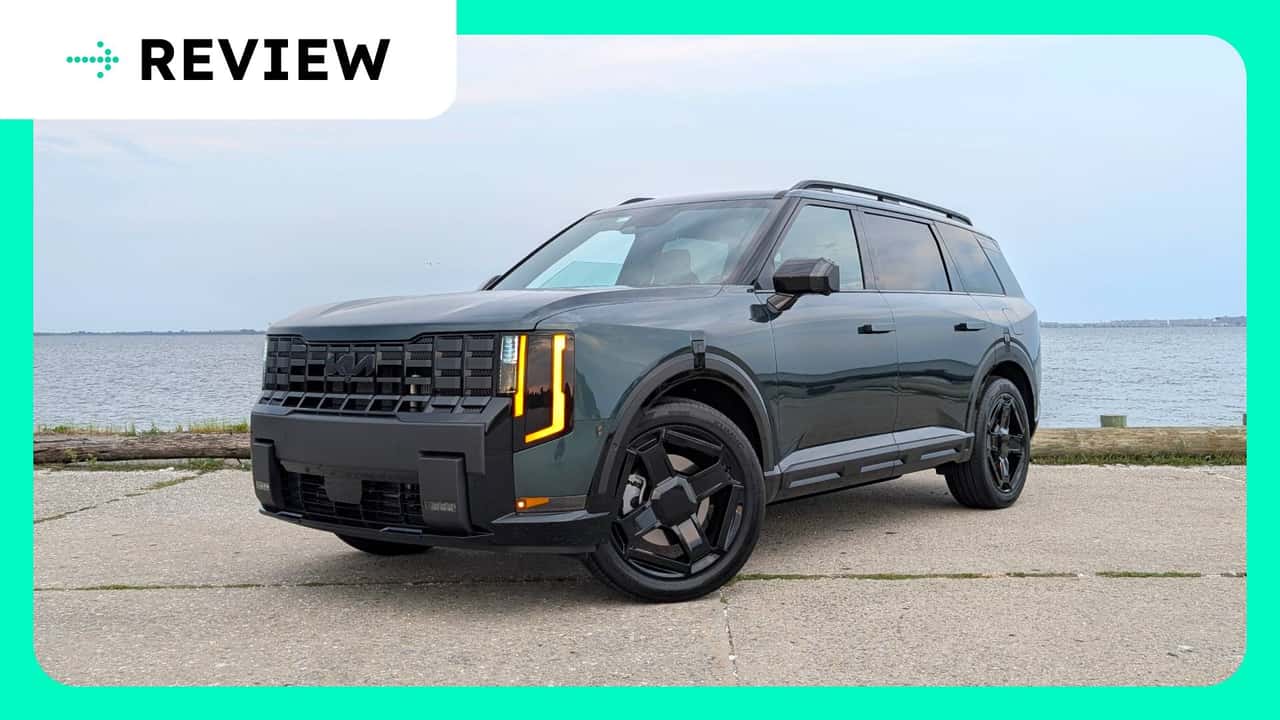
The new Telluride moves away from the rounded styling of the first-generation model. Its body is now more upright and angular, giving the SUV a larger and more imposing appearance. The design has a slightly premium character, with creases around the taillights that recall some Range Rover styling cues.
The tested SX Prestige X-Line model was equipped with a distinctive mesh-style grille instead of the glossy grille used on most trims. It also featured black wheel-arch cladding, skid plates, raised roof rails, and a squared-off lower bumper. Gloss-black 21-inch wheels wrapped in 265/45 Kumho tires completed the rugged appearance.
The result is a vehicle that looks appropriately substantial for a large family SUV. It projects the confidence many buyers expect from a three-row model without appearing excessively flashy.
More power from a new hybrid system
The Telluride Hybrid replaces the previous model’s thirsty 3.8-liter V6 with a turbocharged 2.5-liter four-cylinder engine paired with a parallel hybrid system. A 1.65-kilowatt-hour lithium-ion battery supplies energy to two electric motors, with the complete system producing 329 horsepower and 339 pound-feet of torque.
That represents an increase of 38 horsepower and 77 pound-feet of torque compared with the previous Telluride. Power is delivered to all four wheels through a six-speed automatic transmission. A conventional, non-hybrid Telluride remains available with 274 horsepower and 311 pound-feet of torque, but the hybrid is both quicker and more efficient.
Kia integrated both electric motors inside the transmission rather than mounting one externally with a belt drive. This arrangement reduces frictional losses. Electrically powered accessories, including the alternator and air-conditioning compressor, also help improve efficiency. The hybrid motor is thinner and more power-dense, creating room for a redesigned transmission damper intended to reduce vibration.
On the road, the electric motors provide an immediate burst of torque when the accelerator is pressed. That initial response fades somewhat when the gasoline engine takes over, but the overall delivery remains smooth and predictable. The system does not provide the dramatic acceleration associated with some electric vehicles, though that is not necessarily a problem. The Telluride’s relaxed and linear character suits its role as a family SUV.
Despite a curb weight of approximately 5,000 pounds, the hybrid powertrain makes highway driving feel effortless. Around town, the vehicle frequently operates in electric mode, especially during low-speed driving and while maneuvering through traffic.
Efficiency improves substantially
Fuel economy is one of the strongest reasons to choose the hybrid. During highway-heavy driving in Sport mode, the Telluride returned approximately 30 miles per gallon. That figure was below the EPA’s 35-mpg combined estimate, but using Eco mode and driving more gently should make it possible to move closer to the official rating.
The gas-only Telluride is rated at just 20 mpg combined, making the hybrid a significant improvement. With a full tank and fuel economy near the EPA estimate, the hybrid SUV could travel more than 600 miles before refueling.
The hybrid premium is not insignificant, however. The Telluride Hybrid starts at $48,035 including destination charges, while the tested SX Prestige X-Line AWD model cost $61,180 with options and destination. The hybrid costs roughly $7,300 more than the equivalent gas-powered model, so buyers will need to consider annual mileage, fuel prices, and how long they plan to keep the vehicle.
Comfortable, quiet, and easy to live with
The Telluride’s ride is soft and composed, as expected from a large family-oriented SUV. It absorbs potholes and rough pavement with little drama. There is some fore-and-aft movement over certain surfaces, but the body remains controlled and never feels unstable.
Noise insulation is particularly impressive. Kia uses triple door seals, thicker glass, and sound-deadening films in the front and rear windshields. At highway speeds, the cabin remains remarkably quiet, helping reduce fatigue on long trips.
The vehicle also includes a feature called Stay Mode. Similar to utility modes in Kia and Hyundai electric vehicles, it allows the climate system, infotainment, lighting, and seat functions to operate using energy from the high-voltage battery while the gasoline engine remains off.
Because the Telluride has a much smaller battery than a fully electric vehicle, Stay Mode cannot operate indefinitely. With the air conditioning set to a low fan speed, the system lasted about an hour and 10 minutes. Running the climate system at full power reduced that time to approximately 30 minutes. Still, the feature is useful for waiting in the vehicle without leaving the engine idling.
The system uses navigation information to preserve enough battery charge for this function when the vehicle reaches its destination. It works only with the built-in navigation system, not with Apple CarPlay or Android Auto. The Telluride Hybrid does not currently offer vehicle-to-load functionality, although it does include a conventional three-pin outlet in the cargo area powered by the smaller 12-volt battery.
A spacious and well-equipped interior
Inside, the Telluride is roomy, modern, and family-friendly. The suede-trimmed front seats may feel somewhat firm, but they provide strong support and high-quality materials. The second-row captain’s chairs are arguably the best seats in the vehicle, offering generous legroom, heating, ventilation, large windows, and a panoramic glass roof.
One-touch controls allow the second-row seats to fold and move forward, making access to the third row straightforward. Two average-sized adults can sit comfortably in the rearmost seats, although taller passengers will find the available space tighter. Folding the second and third rows creates 47.7 cubic feet of cargo room behind the second row and 21.3 cubic feet behind the third.
A 12.3-inch central touchscreen and a similarly sized digital instrument display provide a crisp and responsive interface. One especially useful feature is Kia’s blind-view monitor, which displays a camera image in the gauge cluster when a turn signal is activated. The positioning keeps the driver’s attention closer to the road while providing a wider view of adjacent traffic.
The climate controls are less successful. They are placed on a smaller display between the two main screens, and the steering wheel can partially block the driver’s view. Physical controls for temperature, fan speed, and volume are still present, which makes everyday adjustments easier.
The EV9 remains the more advanced choice
Kia’s electric EV9 is a more polished and technologically advanced vehicle overall. It offers better packaging, a smoother driving experience, and the instant, quiet response associated with a dedicated electric powertrain. The difference between the two vehicles is substantial, particularly for drivers accustomed to modern EVs.
However, the EV9 starts at approximately $56,545, making it around $8,000 more expensive than the Telluride Hybrid before comparing equipment and ownership costs. In areas with high electricity prices or limited home charging access, the EV9 may also take many years to offset its higher purchase price through lower operating costs.
For some shoppers, that calculation could stretch to roughly 15 years. The exact result will depend on local fuel and electricity prices, annual mileage, charging habits, and maintenance costs.
The 2027 Kia Telluride Hybrid therefore occupies a sensible middle ground. It offers much of the refinement and efficiency buyers want from electrification without requiring a major change in driving or charging habits. With three-row practicality, strong performance, a quiet interior, and a realistic starting price near $50,000, it is one of the strongest hybrid choices in the large-SUV segment. Fully electric vehicles may eventually become the default option, but for now, the Telluride Hybrid makes a persuasive argument for choosing a hybrid.
All EV Sales Research Team
8/20/2026