
 Buy & Sell
 All EV Sales
 Explore
 Account
 Back to News
 The EV Market Moves Beyond Batteries: New Models, Smarter Charging and the Rise of Electric Mobility
The latest electric-vehicle news points to a market entering a more complicated and competitive phase. Battery range remains important, but automakers, charging providers and mobility companies are increasingly focused on broader questions: how vehicles fit into daily life, how quickly they can be charged, how their batteries age, and how electric transportation can expand beyond private car ownership.
Across the industry, new electric models are arriving in a wider variety of shapes and sizes. Some are designed for families, some for commercial work, and others for camping or lifestyle conversions. The PV7, for example, pairs a large, highly adaptable body with a modular electric platform intended to support multiple uses. That approach reflects a growing desire to build vehicles that can be customized rather than limited to a single configuration.
Electric vans are also becoming more versatile. The Volkswagen ID. California Cruise transforms the retro-styled ID. Buzz into a compact camper van, offering a glimpse of how electric vehicles may serve as both transportation and recreation. A version for the United States is expected as well. These products build on the idea that an EV can be more than an efficient commuter car; it can also function as a mobile living space for road trips, camping and family travel.
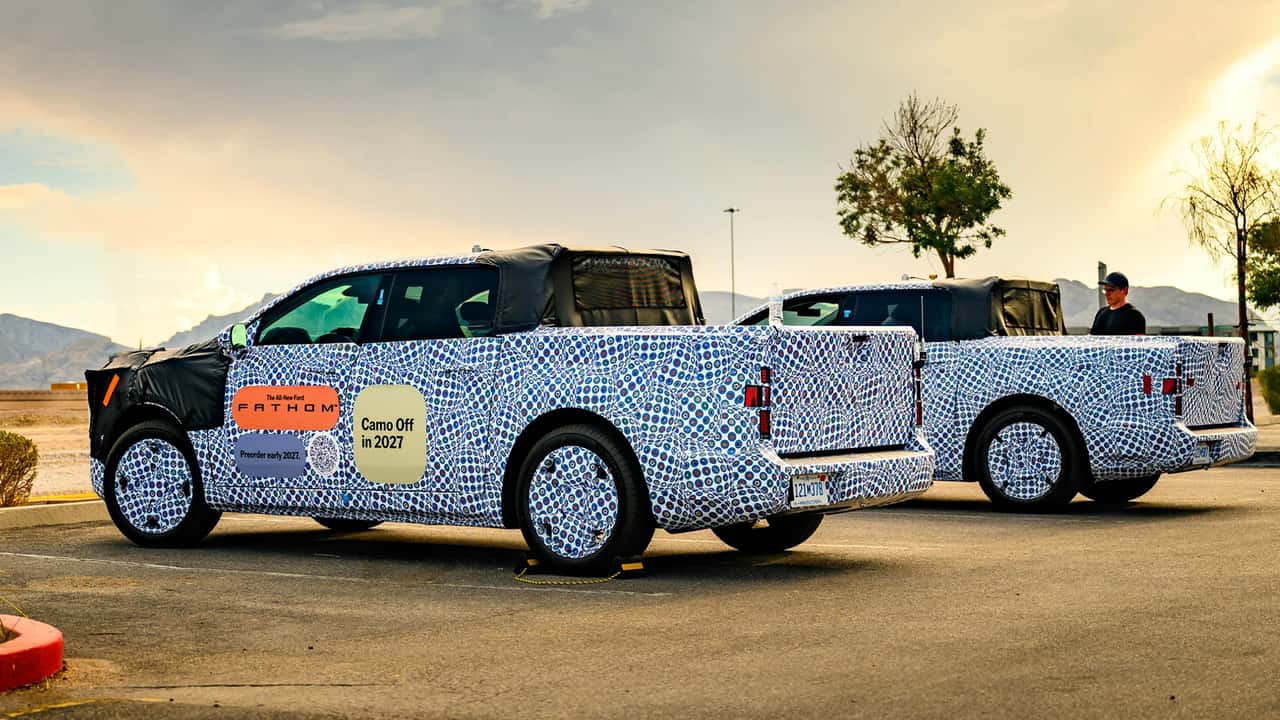
Automakers are continuing to refine familiar vehicle categories too. A forthcoming Volkswagen electric SUV is expected to receive a boxier front end, conventional door handles, revised underpinnings and a new but recognizable name. Ford’s Fathom has been described as a vehicle with a completely new silhouette rather than a conventional pickup, but early images suggest that its shape may be more familiar beneath the camouflage. Meanwhile, an updated EV gains a proper rear window, a larger trunk and a new Camping mode, features that could make it more practical for everyday family use.
The long-awaited electric Range Rover is another important addition. Five years after the model was first announced, the luxury SUV has finally arrived with the promise of combining premium design and off-road capability with electric power. Its launch demonstrates how electrification is moving into increasingly expensive and specialized segments, not just small hatchbacks and mainstream crossovers.
One of the most significant themes in the news is the renewed interest in extended-range electric vehicles, or EREVs. These vehicles use electric motors for propulsion but include a gasoline engine that operates as a generator when additional energy is needed. Supporters argue that the format can deliver the smoothness and responsiveness of an EV while reducing long-distance charging concerns. New programs from Scout, Ford, Hyundai and other automakers suggest that range-extending technology could become a bridge between conventional hybrids and fully electric vehicles.
Battery performance remains a central concern for buyers. Aviloo, an EV diagnostics company, has released findings from thousands of battery health checks covering 20 popular electric models. The results revealed that one model stood out from the rest, highlighting the importance of real-world battery data rather than relying only on official range figures. The findings also reinforce a common misconception: avoiding fast chargers does not necessarily prevent battery degradation. Charging speed is only one factor among many, with temperature, usage patterns, battery chemistry and time also playing major roles.
Charging infrastructure is expanding, but the details of how electricity is delivered matter. Tesla’s Wall Connector may require additional hardware to use all the power available at an installation, while Schneider is including that hardware in the box with its competing product. The difference illustrates how installation complexity and equipment design can affect the ownership experience. In Norway, where EV adoption is exceptionally high, thousands of AC charging plugs have been installed in places where drivers already park. Almost half of Oslo’s cars are electric, showing how convenient, widely distributed charging can support mass adoption.
Public fast-charging networks are expanding as well. BYD’s Flash Charging network has reached 10,000 stations, and roughly one-third of its users drive vehicles made by other manufacturers. That usage suggests that charging networks are becoming shared infrastructure rather than brand-exclusive services. However, not every charging experience is positive. One dealership’s charger reportedly has an extraordinarily high electricity rate by design, demonstrating how pricing transparency and location-based costs remain unresolved issues for drivers.
The competitive landscape is also shifting toward autonomy and shared mobility. Tesla has registered 45 Cybercabs with the Texas Department of Motor Vehicles, with several already appearing on public roads. Another automaker is preparing to work with Waymo on a robotaxi effort. Waymo itself is expanding from warmer regions with mild winters into a city that receives roughly 56 inches of snow annually. That move will test whether autonomous driving systems can perform reliably under difficult weather and road conditions.
Industry cooperation is becoming more common as well. Companies are planning to develop shared hardware and software for vehicles arriving in 2029 and beyond. Such partnerships could reduce development costs, improve compatibility and accelerate the introduction of new electric technologies. At the same time, automakers that missed the recent hybrid boom are reconsidering their strategies. The Nissan Rogue e:Power, for example, could give the Japanese manufacturer a stronger presence in a market where buyers increasingly want some of the benefits of electrification without committing fully to a plug-in vehicle.
Taken together, these developments show that the EV transition is no longer defined by a single breakthrough. Progress is coming from more practical vehicle designs, flexible powertrains, healthier batteries, easier charging, autonomous services and better integration with everyday life. Solid-state batteries may still attract attention, but the next major leap could instead come from improvements in software, charging networks, modular platforms, energy management or vehicle usability. The electric-car market is maturing, and its future will likely be shaped as much by convenience and versatility as by raw range or acceleration.
All EV Sales Research Team
9/2/2026