
 Buy & Sell
 All EV Sales
 Explore
 Account
 Back to News
 Jeep’s first true electric off-roader arrives with serious capability—and a few unfinished edges
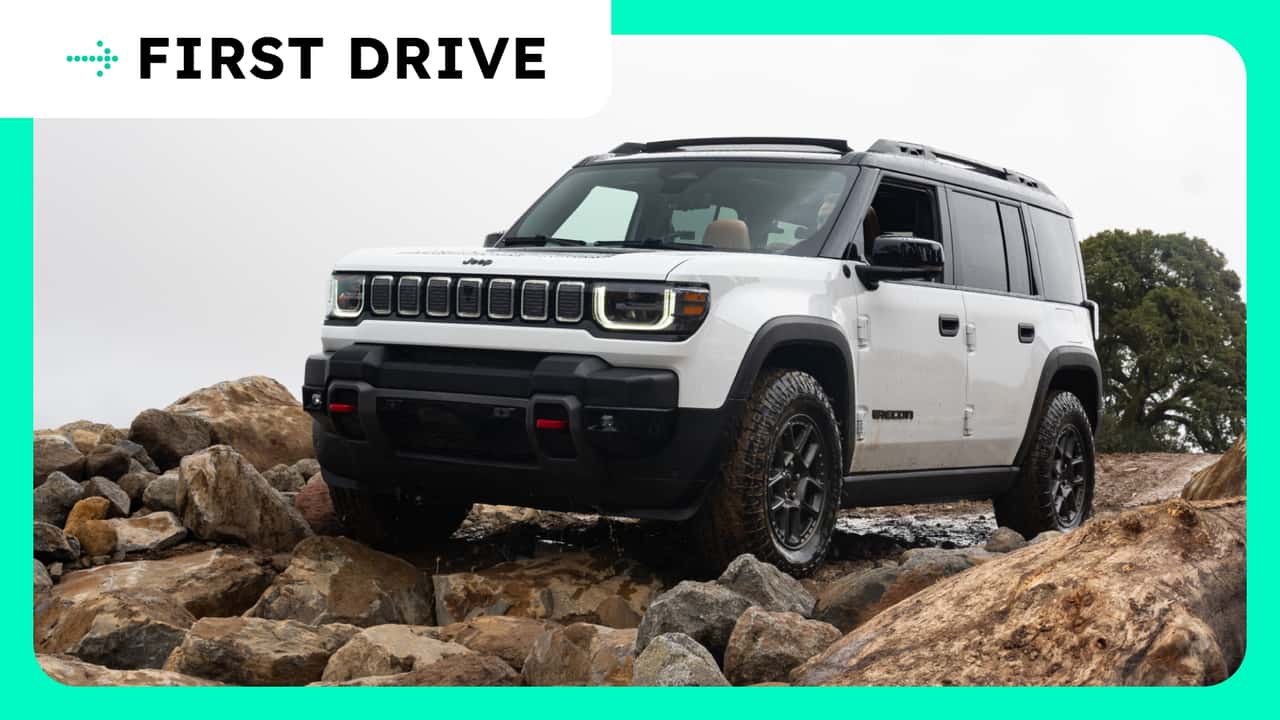
The Jeep Recon Moab is the company’s first electric vehicle that feels unmistakably connected to the brand’s off-road identity. While the Wagoneer S introduced Jeep’s electric ambitions as a powerful luxury crossover, it offered little of the rugged character traditionally associated with the badge. The Recon is different. With removable doors, an open-air cabin, a rear locking differential, chunky 33-inch tires and a familiar upright shape, it is clearly intended to be an electric alternative to the Wrangler.
That does not mean it is a battery-powered Wrangler. In several important ways, the Recon takes a more modern and practical approach. It uses independent suspension at all four corners and a rack-and-pinion steering system, rather than the Wrangler’s solid axles and steering box. Those choices reduce some of the traditional Jeep’s off-road advantages, but they make a significant difference on pavement.
After driving the Recon through California’s Sonoma County, the overall impression is of an EV that successfully captures much of the Wrangler’s character while being substantially easier to live with on the road. It is quick, distinctive and genuinely capable away from the pavement. However, its limited range, high price and inconsistent low-speed calibration keep it from feeling like a completely finished product.
A design that leaves no doubt about its mission
The Recon is easy to identify from a distance. Its square proportions, wide stance, upright windshield and rear-mounted spare tire give it the unmistakable appearance of a Jeep. Unlike the Wagoneer S, which could be confused with a number of other electric crossovers, the Recon looks purpose-built for trails and open-air driving.
The initial offering is the Moab version, positioned as the electric equivalent of a high-performance Rubicon. It comes with the equipment expected of a serious trail vehicle, including a locking rear differential, multiple terrain modes, substantial ground clearance and aggressive approach and departure angles. Jeep lists 9.1 inches of clearance, along with a 33.8-degree approach angle, a 33.1-degree departure angle and a 23.3-degree breakover angle.
Those figures make the Recon well suited to rough forest roads, muddy paths and challenging recreational trails. It can also ford up to two feet of standing water under the right conditions. Still, the vehicle is not designed to dominate the most extreme off-road courses. Compared with a Wrangler, Ford Bronco or body-on-frame pickup equipped with solid axles and greater suspension articulation, the Recon will eventually reach its limits sooner.
The tradeoff is that the Recon is much more comfortable when the trail ends.
A major improvement on the highway
The Wrangler’s solid axles are a major part of its off-road appeal, but they also contribute to its compromised ride, handling and steering. The Recon’s independent suspension and modern steering rack make it far more stable and predictable at highway speeds.
It is arguably the first Jeep on large all-terrain tires that does not feel tiring during a long, straight drive. The steering is more precise, the body feels tighter and the suspension does a better job of controlling the vehicle’s movements. The result is a Jeep that can handle interstate travel and winding two-lane roads without demanding constant corrections from the driver.
That does not transform the Recon into a sports car. It weighs roughly 6,100 pounds, rides on tires intended primarily for off-road use and sits tall above the road. The vehicle can feel unsettled when pushed through corners, with bumps and body lean continuing to reverberate through the chassis. In damp conditions, the tires can also run out of grip sooner than expected.
The powertrain is extremely strong, however. With approximately 670 horsepower and 620 pound-feet of torque, the Recon can accelerate from zero to 60 mph in a claimed 3.6 seconds. That is dramatically quicker than any conventional Wrangler. The instant power makes the Recon entertaining in a straight line, but it does not give the vehicle sports-car handling. Its character is closer to a powerful muscle car: explosive off the line, but not especially tidy in corners.
Range remains the biggest concern
The Recon Moab’s 100.5-kilowatt-hour battery is rated for 222 miles of range. That figure is already modest for a modern electric vehicle, and real-world highway driving will reduce it further. At a steady 70 mph, the combination of a boxy body, tall ride height and knobby tires is likely to push the usable distance between charging stops below 200 miles.
From an engineering standpoint, the result is understandable. A large, upright off-road vehicle requires considerable energy to move through the air, while all-terrain tires create additional rolling resistance. Still, the limited range is difficult to overlook when the Recon starts at nearly $67,000—roughly $17,000 more than a Wrangler Rubicon.
Jeep says the Recon can charge from 10% to 80% in about 23 minutes when connected to a sufficiently powerful fast charger. Longer-range and more road-focused versions are expected, which could make the model more attractive to buyers who want the design and open-air experience without accepting such frequent stops.
Low-speed driving exposes unfinished software tuning
The Recon is less impressive at low speeds than it is on the highway. Throttle response and regenerative braking are not calibrated as smoothly as they should be, particularly for a vehicle designed to spend time crawling over rocks and uneven terrain.
At speeds below about 10 mph, the accelerator can feel overly sensitive, delivering too much power or almost none at all. Coming to a stop can also be awkward, with the vehicle sometimes applying regenerative braking abruptly enough to make occupants lurch forward.
The settings add to the confusion. Drivers can separately adjust regenerative braking and the vehicle’s creep function, but the controls do not behave in the intuitive way many EV drivers will expect. The highest regeneration setting does not activate the smoothest one-pedal experience; instead, turning creep off is what enables that behavior. Even then, the system can feel abrupt.
The most comfortable combination appears to be low regeneration with creep enabled. That setup is easier to manage on the road, although it still does not provide the precise control desirable during technical off-roading. On a short demonstration course, the Recon reportedly bounced and bucked over rocks even when its low-speed off-road cruise control was engaged.
A cabin that blends utility with technology
Inside, the Recon combines practical Jeep details with a relatively upscale presentation. There is a large passenger grab handle, a substantial drive selector and physical controls for important off-road functions. The seats are comfortable, visibility is good and the cabin admits plenty of light through its standard glass roof or available retractable soft top.
The vehicle’s removable components are among its best features. The doors can be taken off without tools, while the rear quarter windows and back glass can also be removed for a more open-air experience. Small replacement mirrors fit into the door mounting points, and a lockable center console helps secure valuables when the doors are left behind. Jeep’s familiar design Easter eggs are scattered throughout the interior as well.
A 14.5-inch central touchscreen runs the Uconnect 5 system, with a 12.3-inch display in front of the driver. Both screens are responsive and easy to read, but the EV-specific software needs improvement. The energy-consumption graphic is difficult to understand, and the built-in navigation does not reliably plan routes around suitable fast chargers. It may even suggest Level 2 charging stations for long-distance travel.
The system also does not clearly estimate the battery percentage expected at the destination. Those omissions are particularly frustrating in a vehicle whose range is already limited.
Verdict: authentic, exciting and not quite polished
The Jeep Recon Moab is not the most refined electric vehicle available, nor is it the ultimate off-road machine. Its range is mediocre, its launch price is high and its low-speed powertrain behavior needs additional tuning. The company is even considering adding a gasoline engine to the model, an indication that Jeep is not yet fully committed to an all-electric future.
Despite those flaws, the Recon is more appealing than its specification sheet might suggest. It feels authentic, delivers the open-air freedom that defines the Wrangler and offers substantially better road manners. It is quick, quiet and capable enough for most recreational off-road adventures, while avoiding the constant compromises of a solid-axle Jeep.
For buyers who want a Wrangler’s style and trail personality but cannot tolerate its highway behavior, the Recon makes a compelling argument. At nearly $67,000, however, it needs better software, smoother low-speed control and more range to feel truly complete. The Recon is a promising first step—and the closest Jeep has come to making an electric vehicle that feels fully like a Jeep—but it still falls short of being the polished product its price suggests.
All EV Sales Research Team
9/9/2026