

Alpine A290 Beats Heavier and Faster Rivals in Electric vs. Combustion Hot Hatch Battle
Electric cars have made enormous gains in acceleration, but outright speed is only one part of the hot hatch formula. Lightweight construction, precise handling, driver involvement and a playful chassis can matter just as much—if not more—when a car is being pushed around a circuit.
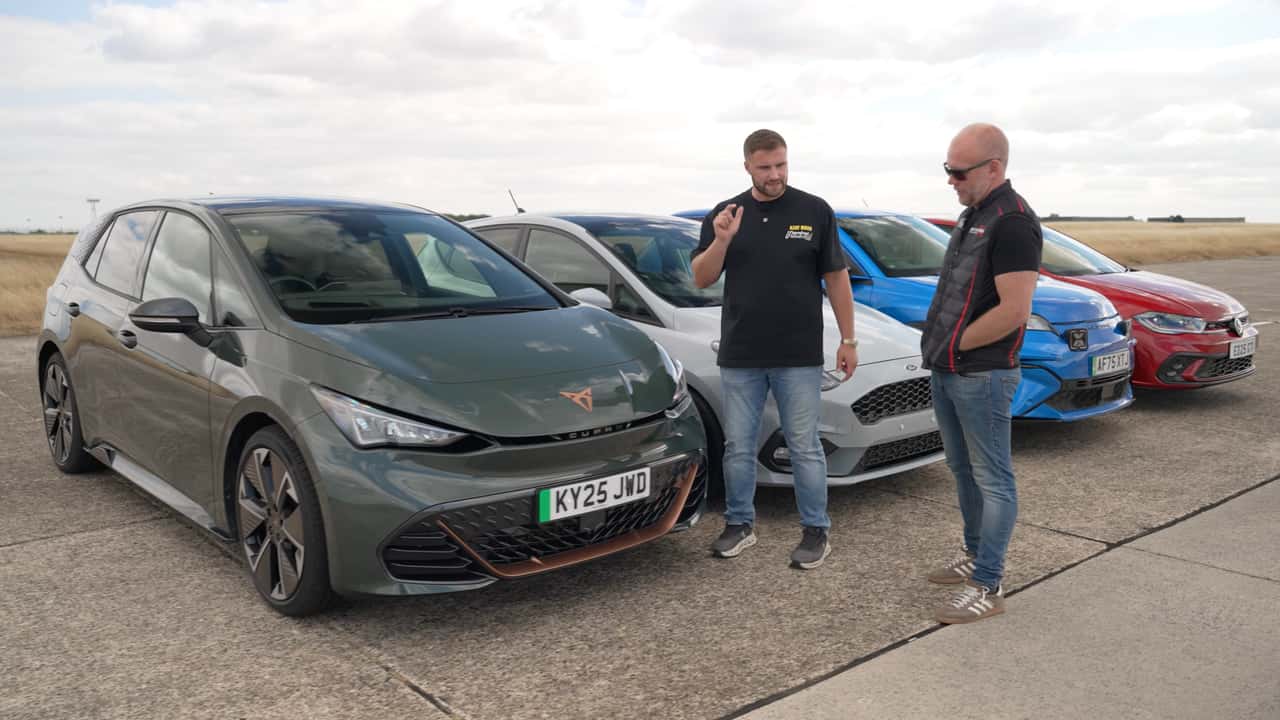
That was the central question in a recent four-car track comparison involving two electric hot hatches and two petrol-powered alternatives. The Ford Fiesta ST, widely regarded as one of the most entertaining small performance cars of recent years, was joined by the electric Alpine A290 GTS, the Cupra Born VZ and the Volkswagen Polo GTI.
On paper, the Cupra appeared to have the clearest advantage. Its rear-mounted electric motor delivers 322 horsepower and 402 pound-feet of torque, allowing it to accelerate from zero to 62 mph in a claimed 5.7 seconds. However, that performance comes with a substantial weight penalty. The Born VZ tipped the scales at approximately 4,407 pounds, or 1,999 kilograms, making it significantly heavier than every other car in the comparison. It also had the largest body and a 79-kilowatt-hour battery pack.
The Alpine A290 GTS took a different approach. Based on the Renault 5, it uses a single electric motor driving the front wheels and produces 217 horsepower and 221 pound-feet of torque. Its 52-kWh battery contributes to a much lower quoted weight of 1,555 kilograms, or roughly 3,428 pounds. Alpine claims a 0-to-62-mph time of 6.4 seconds, which makes it slower than the Cupra in a straight line, but its compact dimensions and more focused chassis promised to give it an advantage through corners.
Neither electric hatchback uses a conventional multi-speed transmission. Both rely on a single-speed reduction gearbox, meaning the driver does not have to shift manually or wait for simulated gear changes. That lack of mechanical interaction can be a drawback for enthusiasts who enjoy the rhythm and involvement of a manual gearbox, but it also provides immediate and consistent power delivery.
The combustion-powered contenders represented a more traditional interpretation of the hot hatch. The Volkswagen Polo GTI used a turbocharged 2.0-liter four-cylinder engine producing 204 horsepower and 236 pound-feet of torque. Power was sent through a seven-speed dual-clutch automatic transmission. With a weight of 2,998 pounds, or 1,360 kilograms, Volkswagen quotes a 6.5-second sprint to 62 mph.
The Ford Fiesta ST was lighter still, weighing approximately 2,767 pounds, or 1,255 kilograms. Its turbocharged 1.5-liter three-cylinder engine generated 197 horsepower and 214 pound-feet of torque, with those figures delivered to the front wheels through a six-speed manual gearbox. Ford also listed a 6.5-second 0-to-62-mph time for the Fiesta.
The circuit results showed why performance cannot be judged solely by acceleration figures. The Alpine completed the lap in approximately 52.9 seconds, taking a comfortable victory despite having less power than the Cupra. The Born finished second with a time of 53.65 seconds, narrowly ahead of the Polo GTI at 53.76 seconds. The Fiesta completed the circuit in 54.63 seconds.
The A290’s victory was particularly notable because its straight-line performance was the least impressive of the four cars. During the test, the driver repeatedly described the Alpine as feeling slow, especially when compared with the instant thrust of the Cupra. Yet that criticism was offset by the car’s cornering ability. Its handling received a perfect 10 out of 10, reflecting the confidence and balance it provided when attacking bends.
The Cupra offered a very different experience. Its additional mass was noticeable, and frequent electronic intervention prevented it from feeling completely natural at the limit. Nevertheless, the Born’s willingness to move its rear end gave it a playful character that the driver found entertaining. Despite the criticism of its weight and electronics, it earned an unusual 11 out of 10 for fun.
The Polo GTI was less successful in creating the same sense of excitement. Its electronic systems and reluctance to execute requested downshifts frustrated the driver, making it feel less responsive than expected from a car with a strong engine and dual-clutch transmission. The Fiesta, by contrast, retained the traditional hot hatch appeal. Its launch control was not especially convincing, so the driver chose to launch the car manually, but there were few other complaints. The lightweight Ford lifted its inside rear wheel through corners and remained highly engaging, earning another 10 out of 10 for fun.
Ultimately, the Alpine A290 GTS emerged as the favorite. The Fiesta still delivered the playful, communicative character expected from a classic hot hatch, while the Cupra proved that a heavy electric car can still be entertaining. However, the Alpine combined the advantages of electric power with a compact footprint and a chassis capable of making the most of every corner.
The comparison demonstrated that electric performance cars do not need the fastest acceleration figures to succeed. In this case, the Alpine’s balance, agility and cornering confidence allowed it to beat more powerful rivals and showed that the most satisfying hot hatch is not always the one with the biggest numbers.