

The review
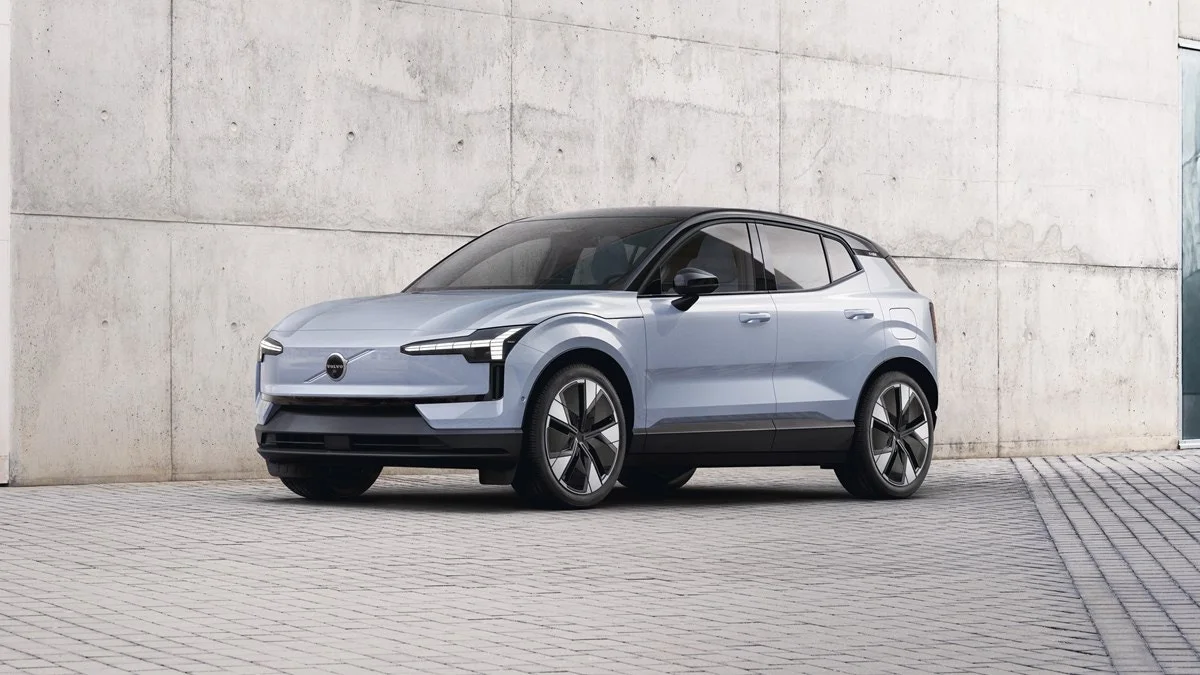
All EV Sales editorial review. Researched from official specifications, safety ratings and published expert reviews; not a first-hand owner review. Key facts Price from: US$38,950 (Single Motor Plus, US, before destination) · £33,050 (UK RRP) · A$49,990 (Single Motor Extended Range Plus, Australia, before on-roads) Official range: up to 261 miles (EPA, Single Motor) · 214–296 miles (WLTP, UK) · 462 km (WLTP, Australia) 0–62 mph: 5.3 seconds (69 kWh single motor) · 3.6 seconds (twin motor, 422 hp) Peak DC charging: 153 kW (69 kWh battery), 10–80% in about 28 minutes · 134 kW (51 kWh battery) Safety: 5 stars Euro NCAP (2024) · ANCAP rated (2024) Overview The EX30 is Volvo's smallest and cheapest electric car, a city-sized SUV sold in the US, the UK and Europe, and Australia. The 2026 range in the US opens with a rear-drive Single Motor at US$38,950 and includes the 422 hp Twin Motor Performance and a raised Cross Country at US$48,150. In the UK the versions are now badged P5 (51 kWh), P5 Long Range (69 kWh) and P8 AWD, plus the Cross Country. Australia sells the 69 kWh rear-drive car in Plus and Ultra trims and the all-wheel-drive Cross Country, and cut prices from 1 April 2026 so the range now starts at A$49,990. One thing to check before buying: reviewers report a battery overheating recall announced in early 2026 for 2024 to 2026 Single Motor Extended Range and Twin Motor Performance cars, with owners asked to limit charging until repaired. Ask the dealer for the recall status of any car, new or used. Design & Interior The EX30 is widely liked for its looks: compact, clean and distinctly Volvo. The cabin uses recycled and textured materials in a minimalist layout that many reviewers find fresh. The sticking point is control. Nearly everything, including the speedometer, runs through the central 12.3-inch touchscreen, and there is no display in front of the driver. Testers in every market call this distracting, and it is the most common reason given for marking the car down. Driving Performance is a strong point. The 69 kWh rear-drive car reaches 62 mph in 5.3 seconds, quick for the class, and the twin-motor version takes 3.6 seconds, which most reviewers consider more than a small SUV needs. The ride is firm but controlled, and UK testers found it quiet on the motorway. It is easy to place in town and stable at speed, though not especially playful. Range & Charging Range is average for the price. Volvo's US figures are up to 261 miles for the Single Motor, 253 miles for the Twin Motor Performance and 227 miles for the Cross Country. UK WLTP figures are 214 miles for the 51 kWh P5, 296 miles for the P5 Long Range, 280 miles for the P8 AWD and up to 264 miles for the Cross Country; the Australian rear-drive car is rated at 462 km and the Cross Country at 417 km. Real-world results are lower: Auto Express saw about 221 miles from the Long Range, and EV Database estimates about 170 miles for the 51 kWh car against 209 miles WLTP. Australian reviewers also mark it down on efficiency. DC charging peaks at 153 kW on the larger battery, with 10–80% in about 28 minutes. Practicality This is where the EX30 gives most ground. The boot holds 318 litres, 904 with the seats folded, and the front boot just 19 litres. Rear legroom is tight for adults, a point every review makes. It works well for one or two people and occasional passengers; it is not a family car. Safety Euro NCAP gave the EX30 five stars in 2024, with 88% for adult occupants, 85% for children, 79% for vulnerable road users and 80% for safety assist. ANCAP's 2024 assessment covers all Australian variants with the same four scores. Euro NCAP noted weak chest protection in the side pole test, marginal driver monitoring and no child presence detection. No IIHS or NHTSA rating was confirmed for the US. Verdict The EX30 suits singles and couples who want a premium badge, strong acceleration and easy parking at a sharp price, especially in Australia after the price cut. Families, tall rear passengers, long-distance drivers and anyone who dislikes touchscreen-only controls should look elsewhere. The closest rivals are the Kia EV3, which is roomier and goes further, the Mini Countryman Electric and the BYD Atto 3. The single-motor 69 kWh car is the pick; the twin motor adds speed the car does not need. How we rated it Range 3.0 (up to 261 miles EPA or 296 miles WLTP, with modest efficiency in testing) · Performance 4.0 (very quick, composed but firm) · Safety 4.5 (five stars Euro NCAP; marked down for touchscreen-only controls and the open battery recall) · Comfort 3.0 (quiet up front, cramped rear seat, small boot) · Overall 3.5 (mean 3.63, rounded to 3.5; no value adjustment). Sources Volvo Car USA, 2026 line-up release (Cision): https://news.cision.com/volvo-car-usa/r/volvo-car-usa-announces-major-upgrades-and-new-models-as-part-of-its-electric-2026-lineup,c4258724 Euro NCAP, Volvo EX30 result (2024): https://www.euroncap.com/en/results/volvo/ex30/53420 ANCAP, Volvo EX30 safety rating: https://www.ancap.com.au/safety-ratings/volvo/ex30/dc3b66 Auto Express, Volvo EX30 review (UK): https://www.autoexpress.co.uk/volvo/ex30 CarExpert, EX30 Australian price cut: https://www.carexpert.com.au/car-news/volvo-slashes-pricing-of-ex30-and-ex40-electric-suvs CarExpert, Volvo EX30 model page: https://www.carexpert.com.au/volvo/ex30 EV Database, Volvo EX30 P5: https://ev-database.org/uk/car/3478/Volvo-EX30-P5