

The review
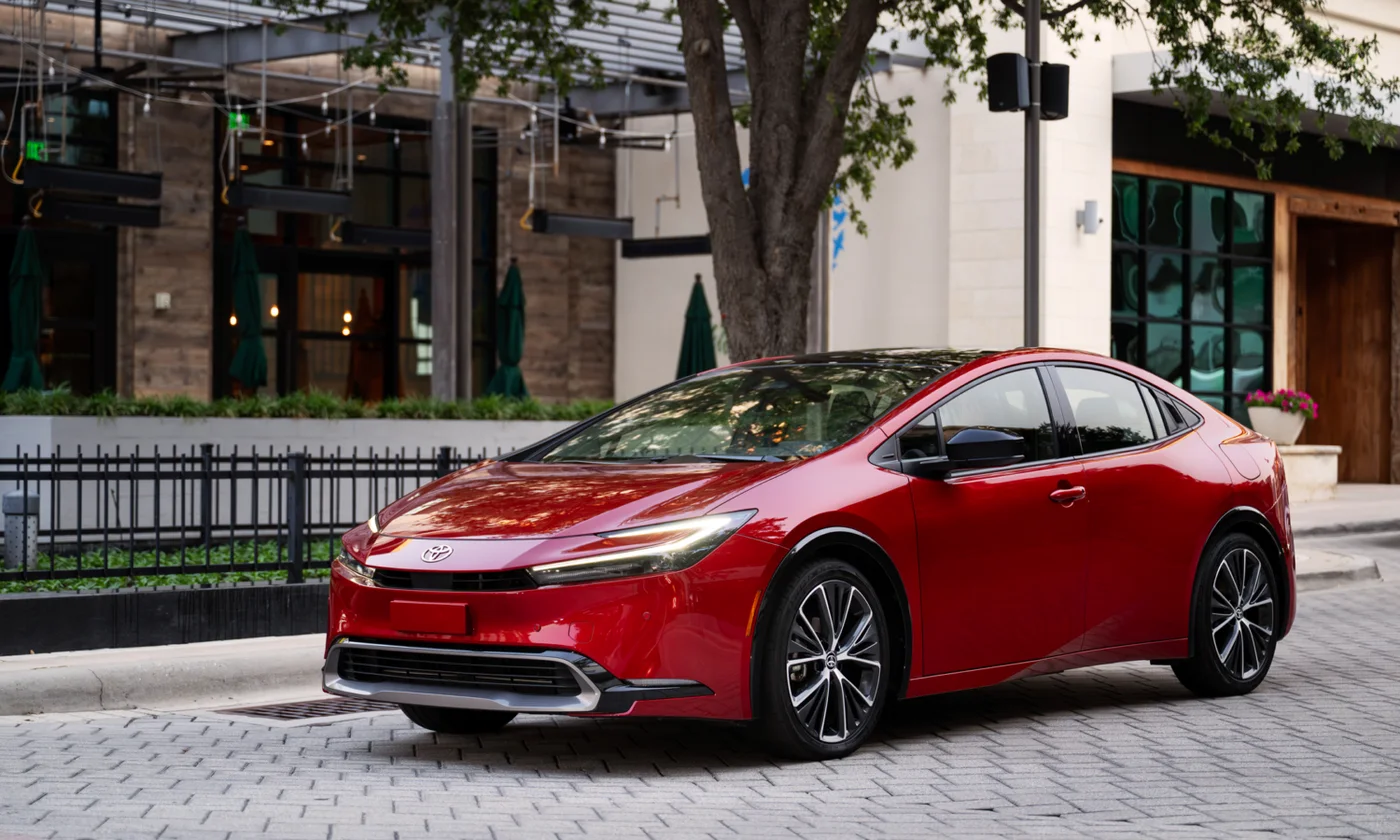
All EV Sales editorial review. Researched from official specifications, safety ratings and published expert reviews; not a first-hand owner review. Key facts Price from: US$28,755 (LE FWD, US, before the US$1,295 dealer processing and handling fee) · £37,895 (Plug-in Hybrid Design, UK, on the road) · not sold new in Australia Official fuel use: 55 mpg combined (LE FWD, EPA; 59 city, 50 highway) · 53 mpg AWD · 48–51 mpg on XLE and Limited Power: 194 hp FWD, 196 hp AWD · 0–60 mph 7.2 seconds FWD, 7.0 seconds AWD (Toyota estimates) Safety: IIHS Top Safety Pick+ (applies to 2027 models) · no Euro NCAP or ANCAP rating for this generation Overview The fifth-generation Prius is the car that turned a sensible fuel saver into something people choose for its looks. The 2027 model is on sale in the United States with small changes: dual-zone climate control and a new black paint colour. What is sold depends heavily on the market. The US gets the regular hybrid reviewed here, with front or all-wheel drive, plus a separate Prius Plug-in Hybrid. The UK and Europe get the plug-in hybrid only. Australia gets neither: the Prius left the local range after four generations, and Toyota Australia said in April 2026 that it has no current plan to bring it back. Design & Interior The low, wedge-shaped body is the main talking point, and UK reviewers agree it has made the Prius desirable. The price of that shape is paid inside: the driving position is low and does not suit everyone. LE, XLE and Nightshade grades have an 8-inch touchscreen; the Limited has a 12.3-inch screen, which is optional on the Nightshade. Wheels are 17-inch on the LE and 19-inch on the XLE and Nightshade. Driving A 2.0-litre petrol engine works with Toyota's fifth-generation hybrid system for 194 hp, or 196 hp with the rear electric motor of the all-wheel-drive version. Toyota's 0–60 mph estimate of about 7 seconds is quick for an economy car. British testers of the plug-in version describe it as the best Prius yet to drive, with tidy handling and a composed ride even on 19-inch wheels. The same reviews note engine drone under hard acceleration and wind and tyre noise at motorway speed. Those judgements come from the plug-in car, which is heavier and more powerful, so they are a guide rather than a test of the US hybrid. Fuel economy This is the reason to buy one. The EPA rates the LE front-wheel-drive car at 55 mpg combined, which is about 4.3 litres per 100 km, and the all-wheel-drive LE at 53 mpg. The better-equipped XLE and Limited on 19-inch wheels are rated at 51 mpg with front-wheel drive and 48 mpg with all-wheel drive, so the cheapest Prius is also the most economical. Few cars without a plug come close. The UK plug-in hybrid has an official electric range of 44.1 to 52.2 miles depending on grade; carwow reports about 40 miles in normal use. Practicality The sloping roof limits the Prius as a family car. Reviewers consistently point to tight rear headroom for adults, and the boot of the UK plug-in is shallow at 284 litres. Toyota's US release does not give a cargo figure for the hybrid. In the UK the warranty is three years or 60,000 miles, which can be extended to 10 years or 100,000 miles if the car is serviced at Toyota dealers. Safety The IIHS gives the Prius its highest award, Top Safety Pick+, with Good results in the small overlap, updated moderate overlap and updated side tests, Good ratings for crash prevention with vehicles and pedestrians, and Acceptable headlights. Toyota Safety Sense 3.0 is standard, including automatic emergency braking with pedestrian detection, full-speed radar cruise control, lane tracing assist and road sign assist, along with blind spot monitoring and rear cross-traffic alert. Euro NCAP has not published a rating for this generation, and with no Australian sales there is no ANCAP rating. Verdict The Prius suits commuters and high-mileage drivers who want the lowest fuel bills available without plugging in, and who usually travel with one or two people. Its strengths are economy, standard safety equipment and styling. Its weaknesses are just as clear: rear headroom, a small boot, a low driving position and noise at speed. Families and anyone who carries tall passengers should look elsewhere, as should UK buyers who cannot charge at home, because the plug-in is the only version sold there and costs far more than the US hybrid. The closest rivals are the Honda Civic Hybrid, the Toyota Corolla Hybrid and the Hyundai Elantra Hybrid. How we rated it Range 5.0 (55 mpg combined is among the best of any car without a plug) · Performance 4.0 (about 7 seconds to 60 mph and tidy handling, some engine drone) · Safety 4.0 (IIHS Top Safety Pick+ and a full standard assistance suite, but no Euro NCAP or ANCAP rating for this generation) · Comfort 3.5 (composed ride, but tight rear headroom, small boot and noise at speed) · Overall 4.0 (mean 4.1, no adjustment). Sources Toyota USA Newsroom, 2027 Prius release: https://pressroom.toyota.com/2027-toyota-prius-designed-to-stand-out-built-on-hybrid-innovation/ EPA fuel economy, 2027 Toyota Prius: https://www.fueleconomy.gov/feg/PowerSearch.do?action=noform&path=1&year1=2027&year2=2027&make=Toyota&baseModel=Prius&srchtyp=ymm IIHS, Toyota Prius ratings: https://www.iihs.org/ratings/vehicle/toyota/prius-4-door-hatchback/2026 Toyota UK, Prius Plug-in Hybrid: https://www.toyota.co.uk/new-cars/prius-plugin Auto Express, Toyota Prius review: https://www.autoexpress.co.uk/toyota/prius carwow, Toyota Prius review: https://www.carwow.co.uk/toyota/prius CarExpert, Prius and Australia: https://www.carexpert.com.au/car-news/toyota-prius-aussie-door-closes-again-for-hybrid-pioneer