
Electric Momentum: Global and Australian Advances Power the Next Wave of EV Adoption
Electric Momentum: Global and Australian Advances Power the Next Wave of EV Adoption
The world of electric mobility is accelerating at a breathtaking pace. From major automakers slashing prices on flagship EVs to governments investing millions in sustainable transport infrastructure, the global shift away from fossil fuels has entered a bold new stage. A review of the latest headlines paints a vivid picture of this transformation — with Australia, in particular, taking significant strides in zero-emission transport adoption across cars, trucks, buses, and even maritime systems.
Toyota’s Big EV Move: More Range, Less Cost
A surprising headline emerged from Toyota, long regarded as a conservative player in the EV space. The Japanese automaker has dropped the price of its first full EV in Australia — the Toyota bZ4X — by an impressive $10,000, even while upgrading the battery capacity, extending the driving range, and boosting overall performance. It’s a notable shift from Toyota’s cautious approach to electric cars, signaling its growing recognition that affordability and practical range are key to capturing a mass market.
For consumers, this means electric vehicles from established global brands are becoming accessible like never before. Toyota’s move could also pressure other manufacturers to revisit pricing strategies, potentially igniting a new wave of competitive price reductions in the Australian market.
Electric Transport Beyond Roads: UK’s Zero-Emission Ferry Sets Sail
The ongoing electrification trend is not confined to roads. Across the Thames in London, the UK’s first fully electric, zero-emission ferry has begun service, marking an important step toward maritime decarbonization. Operated by Thames Clippers, this ferry carries 150 passengers and 100 bicycles, showing that clean technology isn’t just about reducing tailpipe emissions — it’s about reimagining entire urban mobility networks. Watercraft electrification is particularly challenging due to battery weight and charging logistics, making the successful launch of this vessel a major milestone.
Tesla Expands Deeper Into the Outback
While the UK electrifies its waterways, Australia’s vast distances present unique challenges — and Tesla continues to address them. The Northern Territory is set to receive its first Tesla Supercharger station, marking the company’s most northerly expansion in the country. The new location will complete a charging link for thousands of kilometers of remote driving corridors, connecting regions previously underserved by high-speed charging infrastructure.
Tesla’s network has become an integral part of Australia’s EV ecosystem, supporting not only Tesla drivers but increasingly those with other EV models as open-access charging initiatives expand.
Building the Backbone: Industrial and Commercial EV Infrastructure
Australia’s transition is also being bolstered by a flurry of investment in heavy transport infrastructure. In Sydney, Zenobē has opened the nation’s first off-site electric truck charging hub, powered entirely by renewable energy. The hub is designed to support Woolworths’ growing fleet of electric delivery trucks, providing commercial-scale charging away from traditional depots. This innovative model removes one of the biggest logistical challenges facing freight decarbonization — limited charging access at urban logistics hubs.
The Australian government has further reinforced this momentum, partnering with Volvo Group Australia in a $70 million investment program aimed at reducing the cost of domestically made electric trucks. The initiative also supports deployment of charging infrastructure, ensuring the fleet transition for logistics and heavy industry is sustainable and scalable.
Electric Buses Hit the Streets of Adelaide
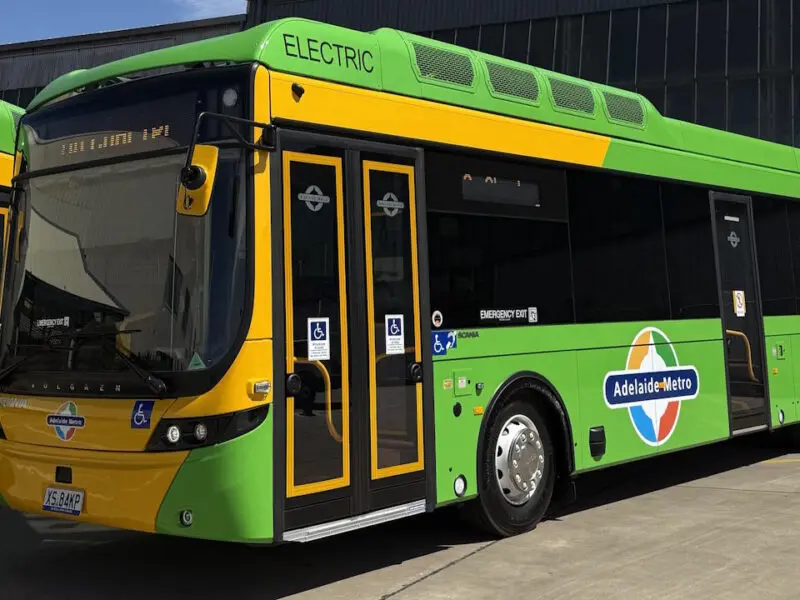
Public transport electrification continues to gain traction, with Adelaide welcoming its first two new electric Scania buses — the initial vehicles of an ambitious rollout of 60 new units. These buses are part of the city’s effort to cut transit-related emissions while modernizing its fleet. Over the next several months, South Australia’s roads will see a noticeable reduction in exhaust fumes and noise pollution as the deployment continues.
Such large-scale rollouts underscore that electric mobility is not restricted to private consumers: it is reshaping how cities themselves function, providing cleaner, quieter, and more efficient shared transport options.
Recycling and Rethinking Energy Flows
Sustainability in mobility doesn’t end at the vehicle’s lifespan. In Victoria, Nissan is repurposing old Leaf EV batteries for energy storage at its castings factory. The system stores solar-generated power, demonstrating how EVs can anchor circular energy economies. As more EV batteries reach end-of-life, such projects show how energy storage and recycling will play crucial roles in reducing waste and improving energy resilience.
Debunking Misconceptions: EV Safety and Range Realities
A recent study revealed that EVs pose no greater threat to pedestrians than petrol vehicles, though hybrid vehicles still show statistically higher accident rates. This finding could help dispel common skepticism about EV safety, particularly at low speeds where engine noise is minimal.
Meanwhile, a separate report examines how EV range ratings are determined and why real-world ranges differ from sticker values. For many first-time EV buyers, understanding that highway speeds, temperature, and driving style can significantly affect range helps set practical expectations — a crucial step toward broader acceptance.
Tesla’s Production Milestone: 4 Million and Counting
Adding to the global momentum, Tesla’s Shanghai factory has hit 4 million vehicles produced, cementing its place as the company’s most productive facility. Many of these vehicles have found their way to Australian roads, highlighting how Asia-Pacific manufacturing hubs are essential to the EV supply chain.
The Road Ahead: Integration and Acceleration
Taken together, these developments illustrate an ecosystem maturing across every level — from individual consumers to city transport agencies and international industrial players. The global EV industry is not just innovating faster; it’s becoming more integrated, circular, and supportive of renewable energy systems.
As prices fall, infrastructure grows, and governments invest strategically, electric transport is shifting from novelty to inevitability. Whether in Australia’s remote highways, London’s bustling rivers, or the solar-charged factories of Victoria, the zero-emission revolution is gathering unstoppable momentum.