
New Wave of Electric Vehicle Momentum: Price Cuts, New Models, and Infrastructure Growth
Australia’s electric vehicle (EV) landscape is undergoing a rapid transformation in 2026, as established automakers and institutions move decisively to make EVs more accessible and appealing. From major price cuts on popular models to large-scale investments in infrastructure and financing, the EV sector is clearly positioning itself for a new phase of mainstream adoption. A review of the latest EV developments paints a vivid picture of a market preparing to accelerate toward mass electrification.
Affordable Power: New Pricing Strategies Across Brands
One of the most notable trends is an effort to lower the entry barriers for consumers. Renault has stepped into the affordability race by announcing a limited-time drive-away price of $49,990 for its fully electric Megane E-Tech. This move is significant because it pushes a well-equipped, European-built EV hatch-crossover into a pricing segment that could appeal to a much broader Australian audience. The offer, valid until the end of the financial year, signals a growing push by automakers to capture price-sensitive buyers who might otherwise opt for conventional vehicles.
BMW, too, has joined this strategy by reducing prices across its iX1 and iX2 models. The German luxury brand is seeking to expand its customer base, particularly as fuel price volatility continues to influence consumer decision-making. These price cuts suggest that even premium marques are recognizing the need to compete aggressively in a fast-evolving EV market where value is becoming a key differentiator.
New Players and Product Expansions
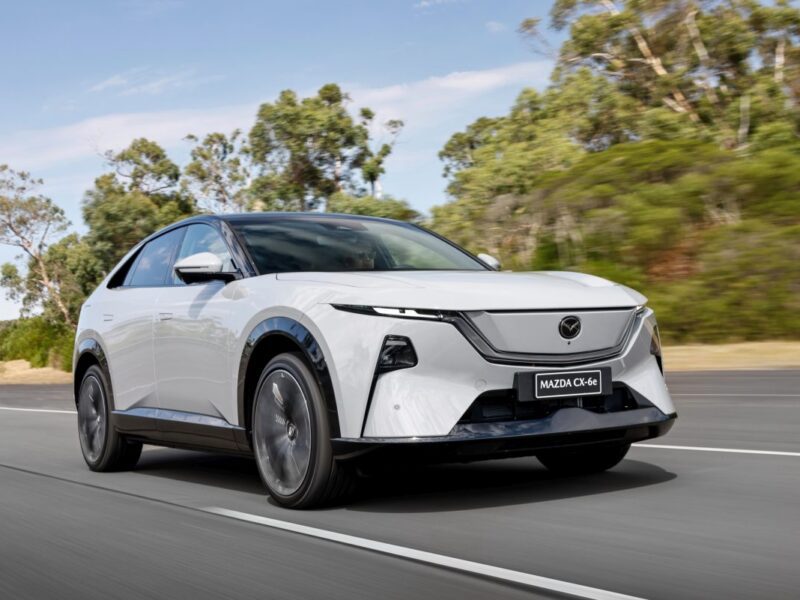
Mazda, a brand long associated with internal combustion vehicles, has revealed the specifications of its new CX-6E electric SUV — an effort that marks its most determined attempt yet to crack the EV market. While Mazda has lagged behind competitors in electrification, the CX-6E may become the brand’s stepping stone into the rapidly growing SUV-dominated EV segment. The company’s design and engineering heritage, combined with consumers’ growing interest in midsize electric SUVs, could finally give Mazda a competitive foothold.
Toyota, which has been more deliberate in entering the EV space, is now expanding with two major announcements. First, it is preparing to launch the long-anticipated Hilux electric ute in Australia after years of testing. However, this model will debut with limited range, underscoring the developmental challenges of balancing performance, utility, and battery capability for large vehicles. Still, the arrival of an electric Hilux — one of Australia’s most popular vehicle platforms — has considerable symbolic weight in signaling Toyota’s shift toward electrification.
Alongside that, Toyota’s updated bZ4X is getting strong attention in reviews for its improved range, faster charging, and reduced price point. The refreshed bZ4X has been characterized as a more mature EV offering — one that better aligns with customer expectations for performance and affordability. Even as Toyota acknowledges that the full transition to electric mobility remains ahead, these incremental advancements demonstrate a growing commitment to EV refinement.
Financing and Market Stimulation
Beyond new models, Australia’s Clean Energy Finance Corporation (CEFC) has announced a $100 million commitment to support discounted EV loans via partnerships with the Volkswagen Group. This plan will make financing more favorable for buyers looking to purchase EVs across brands under the VW umbrella, including Volkswagen itself, Audi, and Škoda. This kind of policy-driven initiative is key to addressing one of the persistent obstacles to EV adoption: up-front cost. With public and private coordination, access to EVs is gradually shifting from aspirational to achievable.
Charging the Infrastructure
Infrastructure growth remains another essential piece of the puzzle, and there are encouraging signs here, too. Australia’s freight and logistics sector has received a major boost with federal funding for three high-powered charging hubs designed for electric trucks. The $61 million project will allow up to 100 heavy-duty electric vehicles to recharge efficiently at strategically located sites, effectively supporting emissions reductions in long-haul transport. This represents an important move toward decarbonizing commercial logistics, often considered one of the toughest sectors to electrify.
Meanwhile, Chargefox — the country’s largest EV charging network — continues to extend its reach through partnerships. In a notable development, a leading oil company has joined the Chargefox platform, adding over 270 new charging plugs. With more than 300,000 users already relying on Chargefox, this cooperation between traditional fuel networks and new EV infrastructure is a sign that even oil giants are repositioning themselves for an electric future.
Accelerating Demand and Market Tipping Point
A subtle but profound change is happening among consumers, too. Demand for EV access is surging, as highlighted by a major energy utility reporting that its EV subscription fleet has been exhausted due to overwhelming demand. The utility’s statement — that it had “none left” — captures the surging appetite for flexible EV ownership models.
Commentators now describe Australia approaching a “tipping point,” where EV adoption may enter an exponential growth phase. External factors such as international instability and oil market fluctuations are expected to further encourage the shift, as households look to reduce their vulnerability to fuel price shocks.
The Road Ahead
Taken together, these developments reveal a dynamic EV environment moving well beyond its early experimental phase. Automakers are cutting prices, financial entities are greasing the wheels of accessibility, and infrastructure providers are stepping up to make electric mobility practical at scale. The period between 2024 and 2026 has proven decisive, and momentum is building across both consumer and industrial sectors. Australia’s journey toward electrification, once incremental, now feels almost inevitable — powered by innovation, collaboration, and a rapidly widening awareness that the electric future is not just coming, but already here.