
 Buy & Sell
 All EV Sales
 Explore
 Account
 Back to News
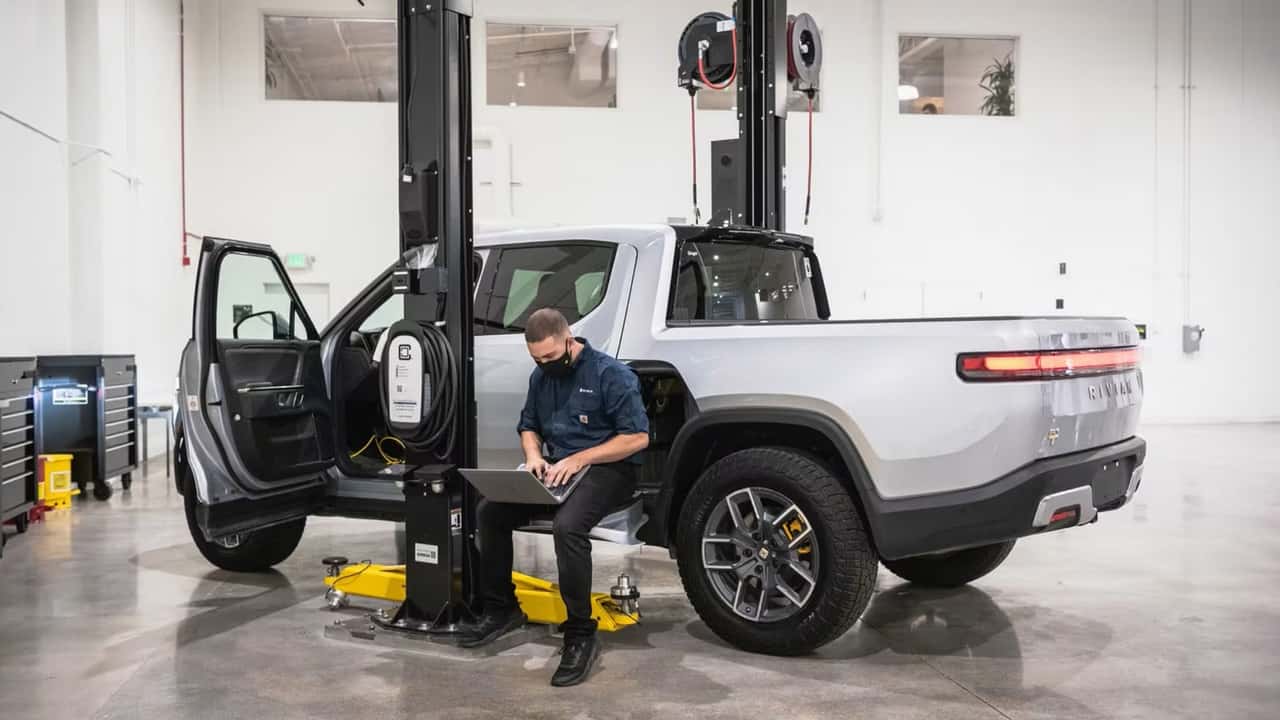
 Buying an electric vehicle from a new startup offers plenty of excitement — cutting-edge design, advanced software, impressive performance — but it also comes with real-world concerns. One of the biggest challenges for emerging EV brands is not just building great cars, but maintaining them. Rivian, one of the most promising players in this arena, is making visible progress on that front. Yet, despite steady improvements, there are still large areas in North America where Rivian drivers would struggle to find a service center if things go wrong.
Over the past year, Rivian has expanded both its physical and mobile service network substantially. The company recently announced that it reached a key milestone in the first quarter of this year by opening its 100th service center across North America. This marks a roughly 35% increase in physical locations compared to the same period last year, when the number of centers stood at 74. The company added service points gradually across subsequent quarters — 81 by the second quarter, 95 by the third, and finally 97 by year’s end — demonstrating a consistent, disciplined expansion effort.
Beyond brick-and-mortar centers, Rivian has also leaned heavily into mobile servicing, a key part of its customer support philosophy. The company now operates a fleet of 680 service vans, which can visit customers directly at home or work to handle many repairs on-site. This strategy helps mitigate one of the most significant disadvantages faced by new automakers: the limited physical presence that legacy brands like Ford, Toyota, or General Motors have built over decades.
Still, even with these positive strides, the company faces a geographical challenge. According to Rivian’s own service network map, vast portions of the United States — including entire states such as North Dakota, South Dakota, Wyoming, New Mexico, Louisiana, Alabama, and Arkansas — currently lack any Rivian service centers altogether. The situation is even more lopsided north of the border: Canada, despite its size and growing EV market, has just two Rivian service facilities. This patchy coverage leaves plenty of potential customers outside easy reach of Rivian’s expanding support network. For drivers in those underserved regions, the company’s mobile repair vans represent the best—and often the only—option for maintenance. However, if a vehicle needs to be lifted, dismantled, or serviced extensively, owners still face the prospect of a long tow to the nearest center.
In tandem with improving after-sales support, Rivian has also expanded its retail footprint through what it calls Rivian Spaces — physical showrooms and brand experience locations designed to introduce new customers to its electric trucks and SUVs. There are now 39 such spaces across the U.S. and Canada, a 44% increase from a year ago. These locations allow prospective buyers to see and test vehicles in person, a vital step for improving awareness and confidence in the still-young brand.
Powering all of this growth is Rivian’s increasing production capacity and its ambition to move from premium, low-volume products into more accessible territory. The upcoming R2 SUV — a smaller, more affordable electric vehicle — is set to play a central role in Rivian's future. The company is preparing its assembly lines for large-scale output, hoping to deliver its first units soon. The R2 is expected to bring Rivian ownership to a broader audience, especially those who may have found the brand’s flagship R1T pickup or R1S SUV out of reach.
As this new, more mainstream model enters the market, Rivian’s ability to support a much larger customer base will be tested. The company’s Adventure Network, Rivian’s own version of a proprietary DC fast-charging system, is another component of this preparedness. With 973 charging stalls already in operation — nearly 1,000 in total — Rivian’s network has grown by 38% in the past year. This rivaling of Tesla’s early model of vertically integrated infrastructure signals that Rivian wants more control over the complete ownership experience, from energy delivery to maintenance.
However, scaling support infrastructure remains one of the most complex and capital-intensive challenges for any automaker. For Rivian, the focus is now not just about building more centers, but placing them strategically across key markets. The wide gaps in the interior states of the U.S. suggest that suburban and rural coverage remains a low priority compared to high-density markets. As the R2 moves into mass production, this imbalance could become a bottleneck in the company’s growth.
Reliability has also been an area of concern for Rivian. Industry surveys have ranked its vehicles toward the bottom in dependability, largely due to software and fit-and-finish issues typical of young automakers. For the R2 — expected to sell in the hundreds of thousands — the tolerance for such issues will be much lower. Ensuring that those buyers have easy and timely access to service will be crucial for retaining customer trust.
Rivian is clearly evolving from startup to established automaker. Its milestones in network growth, charging infrastructure, and customer engagement indicate real progress. Yet, the gaps that remain across the map highlight just how much work is still required to provide a truly nationwide support system. As production ramps up and vehicles spread farther from coastal hubs, Rivian’s ambitious service network will need to grow just as fast to keep pace with its expanding fleet.
All EV Sales Research Team
5/4/2026