
 Buy & Sell
 All EV Sales
 Explore
 Account
 Back to News
 A New Contender in the Electric Vehicle Arena
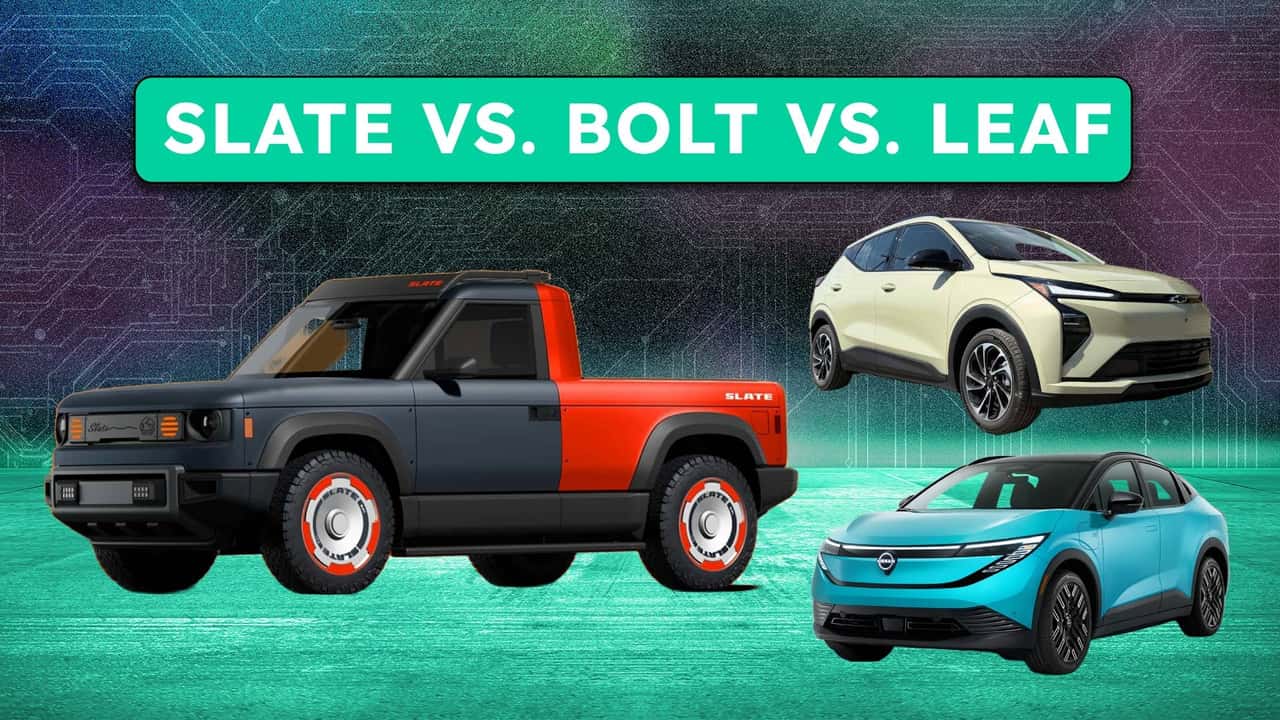
The upcoming Slate electric truck is positioning itself as the most affordable EV on the U.S. market, with production units set to arrive by the end of the year. At a starting price of $24,950 before destination and fees, it undercuts every other EV currently for sale, including the compact Chevrolet Bolt and Nissan Leaf. With no direct rival in the sub-$25,000 category, Slate is seeking to redefine what an entry-level electric vehicle can be.
Compared to the Bolt and Leaf—both hovering around the $30,000 range—the Slate’s advantage lies squarely in affordability. However, the question is whether its low price tag can offset the compromises it makes in performance, equipment, and driving range.
Range and Battery Performance
Range is a decisive factor for EV shoppers, and here the Slate is competitive but not class-leading. Its manufacturer-estimated 205-mile range comes courtesy of a 65-kilowatt-hour lithium-iron-phosphate (LFP) battery. This chemistry favors longevity and thermal stability over energy density, two traits that help keep costs low but limit overall range. The Chevy Bolt uses a similarly sized LFP pack but stretches its driving distance to around 262 miles per charge. Meanwhile, the Nissan Leaf S+ leads this budget trio with a 75 kWh battery and a range of roughly 303 miles.
Part of the Slate’s shorter range stems from its pickup silhouette, which is far from aerodynamic. Slate engineers have acknowledged that other forthcoming variants—the SUV and the fastback—should see slight range gains due to improved aerodynamics. The truck’s capabilities as a light-duty hauler also affect range; with a 2,000-pound towing rating and a 1,500-pound payload capacity, carrying or pulling heavy loads will inevitably reduce efficiency.
Whether owners treat the Slate as a tool for small-business operations or a personal commuter remains to be seen, but its design reflects an intent to serve both purposes.
Charging Tech and Infrastructure Access
Despite its low-tech interior, the Slate truck shares modern charging compatibility with pricier EVs. All three vehicles—the Slate, Bolt, and Leaf—are equipped with the North American Charging Standard (NACS) port, giving access to Tesla’s Supercharger network of over 27,500 stations nationwide. Each model can also utilize CCS chargers through an adapter.
The Slate charges from 20 to 80 percent in about 30 minutes at its 120-kilowatt peak rate. In comparison, the Bolt and Leaf both peak around 150 kW; Chevrolet says its EV can manage a 10 to 80 percent charge in 25 minutes, while Nissan estimates the Leaf needs roughly 35 minutes for the same window. While not the fastest in its segment, the Slate’s charging time remains reasonable for a truck that costs notably less.
Cabin Simplicity and Tech Trade-Offs
Inside, the Slate takes a refreshingly analog approach. The base model includes cloth seats, manual windows, air conditioning, and steering wheel-mounted controls—but notably omits an integrated infotainment screen. Instead, users rely on their smartphones for navigation and media, using an included mount. This strategy caters to minimalists and cost-conscious drivers comfortable using their phones as digital dashboards.
By contrast, both the Leaf and Bolt arrive with large touchscreens, wireless connectivity, and built-in Google infotainment systems that assist with route planning and automatically recommend charging stops. The entry-level Leaf variant lacks integrated Google Maps but still supports wireless Apple CarPlay and Android Auto, both of which are expected to broaden route-planning capabilities soon. The tech disparity highlights Slate’s deliberate back-to-basics philosophy.
Performance and Driving Feel
None of these budget EVs will win drag races, though the Bolt and Leaf edge slightly ahead in acceleration. The Leaf generates 214 horsepower and 261 pound-feet of torque, the Bolt outputs 210 hp and 169 lb-ft, and both reach 60 mph in under seven seconds. The rear-motor Slate trails with 181 hp and 195 lb-ft, taking approximately eight seconds to reach highway speed.
Initial impressions of the Slate hint at lively acceleration and satisfying torque delivery, hallmarks of electric drivetrains. One early review praised its responsiveness and described it as surprisingly entertaining to drive—high praise for a bare-bones pickup aimed at affordability.
Customization and Value Proposition
What the Slate lacks in sophistication it makes up for with customization. The company offers over 200 accessories, most priced under $500, spanning from center consoles and upgraded seat covers to door inserts and decorative trim. Buyers can also select among 30 themed accessory packs or opt for alternate body styles such as the SUV or fastback, though these configurations add $5,000 to $7,000 to the total cost. Even so, the Slate remains cheaper than most comparable EVs and introduces a level of modularity rarely seen in vehicles today.
Safety basics—including airbags, traction control, forward collision warning, and a backup camera—are all standard. Its utility-focused layout includes a frunk with 7.0 cubic feet of storage and a five-foot bed offering 35.1 cubic feet. Compared to the well-equipped cabins of the Bolt and Leaf, the Slate feels sparse, yet intentional in its simplicity.
The Bottom Line
At $24,950, the Slate truck is a statement against ballooning EV costs. It strips away luxury features and high-tech interfaces to deliver a simple, customizable, and genuinely accessible electric vehicle. Buyers seeking refinement or range will likely prefer the more polished Bolt or Leaf, but for those who value affordability and modular design, the Slate represents an intriguing new path for electric mobility.
As deliveries approach, the industry will be watching closely. If drivers embrace its no-frills, build-it-your-way ethos, the Slate might just reshape expectations for what an entry-level EV can be.
All EV Sales Research Team
6/24/2026