
 Buy & Sell
 All EV Sales
 Explore
 Account
 Back to News
 EV Industry Enters a New Phase of Expansion, Competition, and Scrutiny
The electric-vehicle industry is moving into a more complicated stage of development. The latest news spans charging infrastructure, commercial vehicles, performance cars, robotaxis, battery efficiency, international trade, and regulatory oversight. Taken together, these developments show an industry that is expanding rapidly while confronting tougher questions about cost, capability, safety, and long-term sustainability.
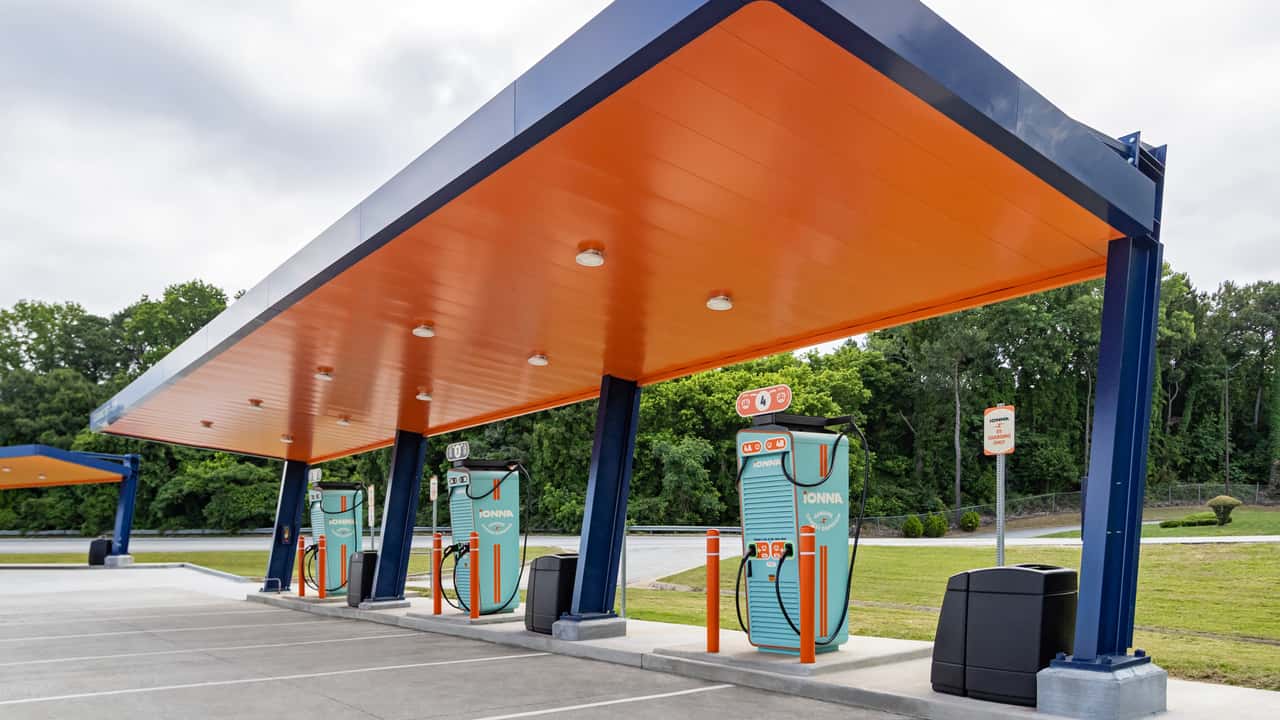
One of the clearest trends is the continued build-out of charging infrastructure in the United States. A manufacturer-backed American charging network is continuing to expand, while EVgo is still supporting older vehicles such as the Nissan Leaf. That attention matters because early electric cars often use charging standards and hardware that are becoming less common. Keeping those vehicles on the road will require networks to maintain compatibility rather than focusing exclusively on the newest and fastest-charging models. The growth of charging networks also reflects the broader effort to make electric transportation more practical for drivers who cannot charge at home.
The commercial-vehicle market is developing along a different path. An American-built electric big rig demonstrates the trade-offs facing battery-powered trucks: adding battery capacity can increase driving range, but it also reduces the payload available for freight. Unlike passenger-car buyers, trucking operators calculate every pound and every mile in terms of revenue. The most successful electric trucks may therefore be those designed around predictable routes, depot charging, and careful fleet planning rather than maximum range alone.
Passenger vehicles continue to face a similar balancing act. Drivers want more range, lower prices, and no loss of capability, but batteries remain expensive, heavy, and resource-intensive. Improving one area often affects another. A larger battery can provide additional range but raises the vehicle’s weight and price. Faster performance can require more powerful motors and cooling systems, while rugged features and four-wheel drive can reduce efficiency. Recent testing of Toyota’s bZ, C-HR, and bZ Woodland models highlights how vehicles built on related foundations can deliver noticeably different value depending on their design and equipment.
Efficiency remains one of the simplest ways for drivers to improve real-world range. Testing continues to show that slower speeds can produce surprisingly large gains because aerodynamic drag rises rapidly as speed increases. This lesson is particularly important as automakers try to control battery costs. Better software, improved aerodynamics, efficient tires, and more measured driving can sometimes deliver meaningful range improvements without adding battery cells.
Technology is also pushing electric vehicles into more specialized categories. A high-performance EV is reportedly incorporating technology developed in partnership with SpaceX, demonstrating how electric cars are becoming platforms for advanced software, power electronics, and lightweight engineering. At the opposite end of the market, a long-serving electric taxi is showing that battery packs and motors can remain dependable after years of heavy use. Such examples may help counter concerns about battery longevity, although real-world durability will vary according to climate, charging habits, mileage, and maintenance.
The distinction between peak and continuous power is another reminder that EV specifications require context. Peak output describes the power a drivetrain can deliver for short bursts, such as hard acceleration. Continuous output indicates what the system can sustain for much longer periods. Both figures matter, but they answer different questions. A vehicle with a high peak rating may feel exceptionally quick without being designed to maintain that output indefinitely. Understanding the difference can help consumers interpret performance claims more accurately.
Autonomous driving and robotaxis remain among the industry’s most ambitious projects. A Croatian startup backed by Rimac is working with a Chinese autonomous-vehicle company to advance robotaxis in Europe, illustrating the increasingly international nature of self-driving development. Tesla is also preparing a purpose-built robotaxi, though its inability to slow-charge from a conventional plug suggests that fleet vehicles may use specialized charging systems. These projects face technical, legal, and operational challenges, including weather, road complexity, passenger safety, and public acceptance.
Regulation is becoming just as important as engineering. A U.S. congressman is asking the National Highway Traffic Safety Administration to investigate continued misuse of Tesla’s Full Self-Driving software, while lawmakers are also debating how the United States should respond to China’s growing automotive influence. One senator has pointed to rumors that a future meeting with China could affect access for Chinese EVs. The issue is not limited to vehicle imports. It includes batteries, software, minerals, manufacturing capacity, supply chains, and the competitive position of American automakers.
China’s EV and plug-in hybrid exports have reached new highs even as domestic sales growth weakens. That shift could intensify competition in overseas markets, where automakers are already weighing tariffs, local-production requirements, and national-security concerns. Meanwhile, Li Auto appears to be accelerating its international ambitions, moving up plans to introduce an EV outside China before the end of the year rather than waiting until 2028.
Traditional automakers are responding with broader electric lineups and upgraded driver-assistance systems. Audi’s most efficient model is entering production in Ingolstadt, while Volkswagen is adding a new suite of assistance technology to Atlas, Golf, and Tiguan models. Tesla has also made an especially delayed electric-pickup feature officially available, showing how software updates can continue to change a vehicle after delivery.
Finally, the wider technology ecosystem surrounding EVs is attracting enormous investment. Elon Musk’s tunneling company is now valued at $23 billion, reflecting continued interest in infrastructure concepts that could eventually influence urban transportation. Although underground transport and electric vehicles are separate technologies, both are part of a broader effort to rethink how people and goods move.
The overall picture is neither a simple boom nor a retreat. EV adoption is expanding, but the market is becoming more disciplined. Buyers are demanding value, fleets are measuring payload and uptime, regulators are scrutinizing driver-assistance claims, and governments are treating automotive competition as a strategic issue. The next phase of electrification will be defined not only by longer range or faster acceleration, but by affordability, reliability, infrastructure, safety, and the ability to integrate electric transportation into everyday life.
All EV Sales Research Team
9/14/2026