
 Buy & Sell
 All EV Sales
 Explore
 Account
 Back to News
 The EV Market Is Entering a More Complicated Phase
The latest electric-vehicle news points to an industry that is continuing to expand technologically while becoming more cautious commercially. Automakers, charging companies, fleet operators, and policymakers are all pushing electric transportation forward, but they are doing so under very different constraints. The result is a market defined by major advances in range, autonomy, charging, and efficiency, alongside delayed vehicle programs, regulatory uncertainty, and a growing debate over affordability.
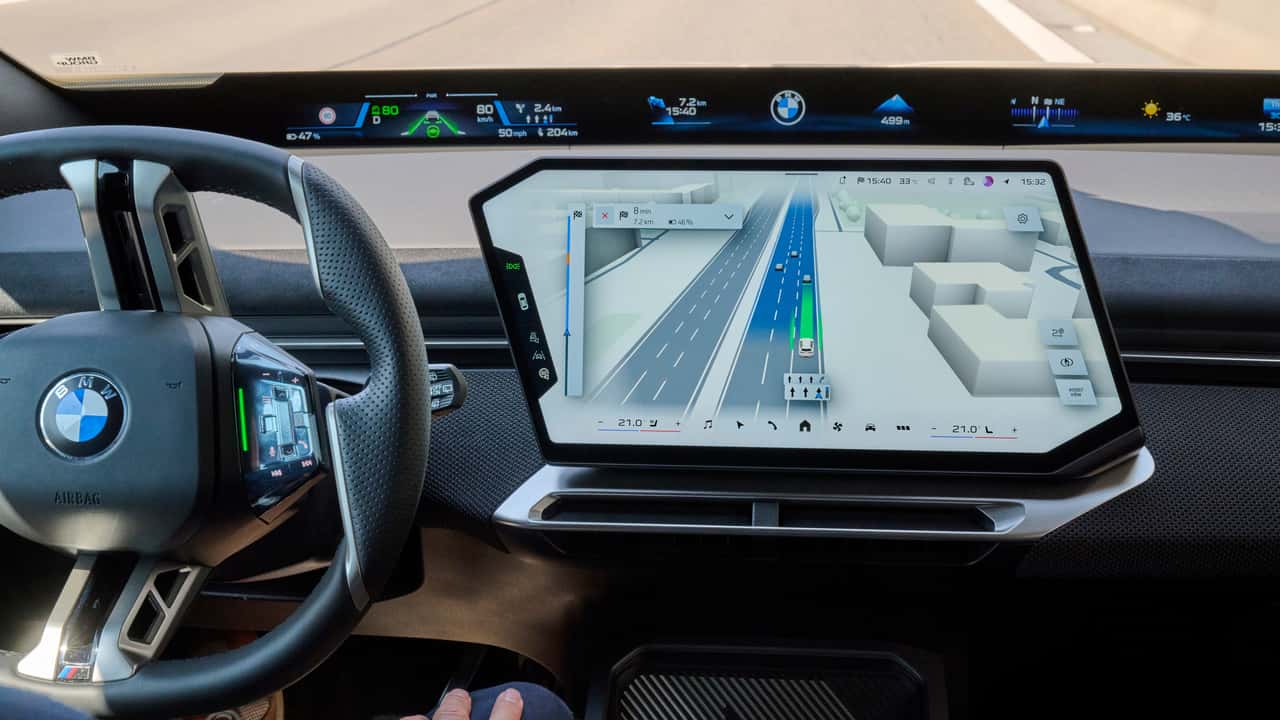
One of the clearest trends is the integration of driving information into a more unified digital experience. BMW’s new iX3 is expected to introduce an updated system that combines navigation guidance and driver-assistance information in a single view. Rather than presenting route information and automated-driving alerts as separate functions, the approach aims to make them easier to understand at a glance. This reflects a broader industry effort to improve the way drivers interact with increasingly capable software. As vehicles take on more responsibility, the quality and clarity of the interface may become nearly as important as the underlying sensors and computing hardware.
Advanced driving systems are also progressing, although automakers remain careful about how quickly they bring them to market. Hyundai has indicated that its internally developed advanced driver-assistance technology will not arrive until 2029 because the company does not want to release what it views as a merely “middling Level 2++” system. At the same time, Tesla’s continued promotion and use of Full Self-Driving software is drawing renewed scrutiny, with a member of Congress asking the National Highway Traffic Safety Administration to investigate alleged misuse. Together, these developments highlight the tension between technological ambition, marketing claims, safety expectations, and the legal responsibilities of drivers and manufacturers.
Autonomous trucking is moving forward as well. Einride has received a first-of-its-kind permit allowing its Level 4-capable truck to operate on German public roads. The permit is significant because it moves autonomous freight technology beyond closed facilities and test tracks into a more realistic regulatory environment. Electric trucks are also becoming more capable in conventional operations. The ETT 44 electric semi is reported to feature a massive 651-kilowatt-hour battery and megawatt charging capability, while an American-built electric big rig is taking a different approach by prioritizing payload over maximum range. These competing designs illustrate that there is no single ideal electric truck. Long-haul transport, regional delivery, construction, and logistics each require different compromises between battery size, cargo capacity, charging time, and operating cost.
Passenger vehicles are seeing their own improvements in range and efficiency. Future Volvo XC60 and XC90 plug-in hybrid models are expected to offer more than twice the electric range of current versions, potentially allowing many drivers to complete everyday trips without using gasoline. Plug-in hybrids remain controversial among EV advocates, but larger batteries can make them substantially more useful when owners charge regularly. Meanwhile, a near-production efficiency-focused EV based on the same underpinnings as the Volkswagen ID. Polo is designed to maximize energy consumption rather than performance or size. Its development reflects the importance of efficiency as automakers seek to deliver more miles from smaller, less expensive battery packs.
Affordability remains one of the industry’s biggest challenges. Some new electric products are targeting prices below $15,000 with equipment included, suggesting that low-cost electric mobility is still possible in selected markets and vehicle categories. However, consumers generally want longer range, lower prices, and no reduction in features or capability. Those goals are difficult to achieve simultaneously because larger batteries, advanced electronics, safety systems, and powerful motors add cost. Although recent pricing data may give American EV shoppers a reason to reconsider electric vehicles, the broader market continues to wrestle with high vehicle prices and uneven access to charging.
Charging infrastructure is expanding despite these obstacles. The manufacturer-backed American charging network mentioned in the news continues to grow, while new deployments are reaching additional cities such as Las Vegas. The expansion is especially important as competing autonomous ride-hailing services establish operations in the same metropolitan areas. A dependable fast-charging network is essential not only for private owners but also for robotaxis, delivery fleets, and commercial trucks that must keep operating throughout the day.
The policy environment, however, remains unsettled. The number of paused, canceled, or delayed EV programs is increasing as automakers respond to changes in government policy, consumer demand, and investment conditions. Washington is also considering ways to counter China’s influence in the automotive sector, raising questions about tariffs, domestic manufacturing, supply-chain rules, and the availability of affordable vehicles. Political attitudes toward EVs are similarly fluid: Donald Trump has said during a Fox News appearance that he could support electric vehicles if they were made domestically, although current laws and industrial realities make that difficult.
International competition is adding another layer of uncertainty. Li Auto, which previously suggested it would not expand globally until 2028, now plans to launch an electric vehicle outside China before the end of this year. Chinese automakers are increasingly looking overseas as their domestic market becomes crowded, while governments in Europe and North America consider how to protect local manufacturers without limiting consumer choice.
Finally, real-world durability continues to shape perceptions of electric vehicles. One high-mileage EV reportedly remains on its original battery and motors and still drives like new after spending much of its life as a taxi. Examples like this challenge concerns about battery degradation and could strengthen confidence in used electric vehicles. At the same time, technical discussions are becoming more sophisticated: peak power available for short bursts is different from the sustained power a drivetrain can maintain over longer periods. Understanding that distinction matters for towing, performance driving, commercial use, and battery management.
Taken together, the news suggests that the EV transition is neither stalled nor proceeding in a simple straight line. Vehicles are becoming more efficient, autonomous systems are growing more capable, trucks are adopting larger batteries and faster charging, and infrastructure is expanding. Yet affordability, regulation, manufacturing policy, and consumer expectations continue to impose limits. The next stage of the market will likely be defined not by a single breakthrough, but by how effectively the industry balances capability, cost, safety, and practical everyday use.
All EV Sales Research Team
9/15/2026